
No. Artificial turf does not fix drainage.
We put artificial turf in the back yard and gravel down the side yard of a Dallas–Fort Worth house that had a standing-water problem. The water problem went away. The turf had almost nothing to do with it.
What fixed it was a buried perforated pipe running the length of the side yard, picking up the downspouts on the way, and daylighting at the curb out front. The turf and the gravel went in on top of that pipe, after it was already working. If we had skipped the pipe and laid turf on the same wet ground, we would have spent the money and still had a wet yard — only now we would not be able to see it, because the water would be sitting under a mat instead of pooling where we could watch it.
That distinction is the whole point of this page, and it is the thing most pages on this topic get backwards. “Artificial turf has a permeable backing, so it drains” is true and almost entirely beside the point. Permeable backing tells you water can get through the turf. It tells you nothing about where the water goes once it reaches the dirt underneath — and that is the only question that matters.
Below is the whole job, photographed start to finish, on one house.
What the yard looked like first
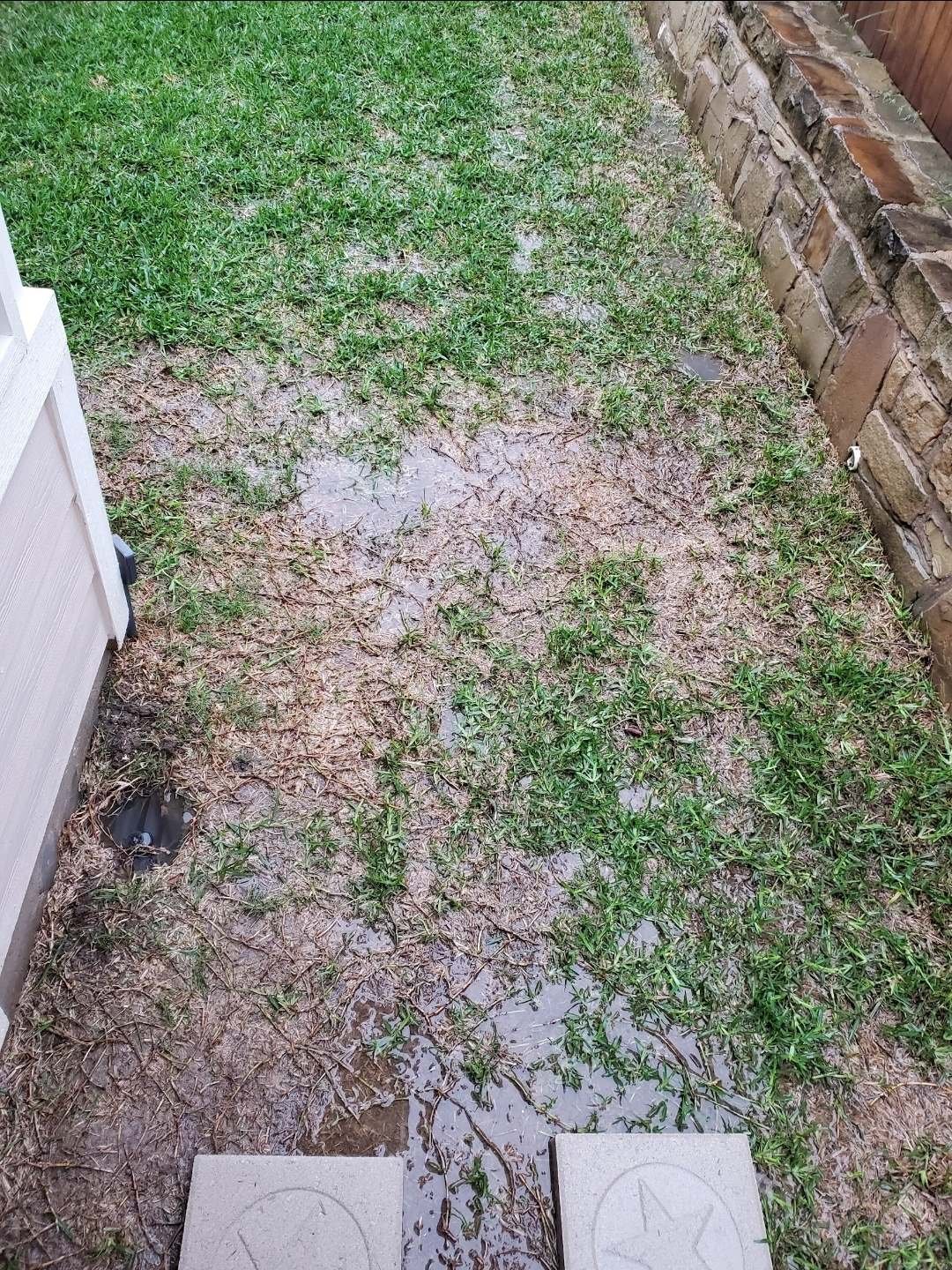
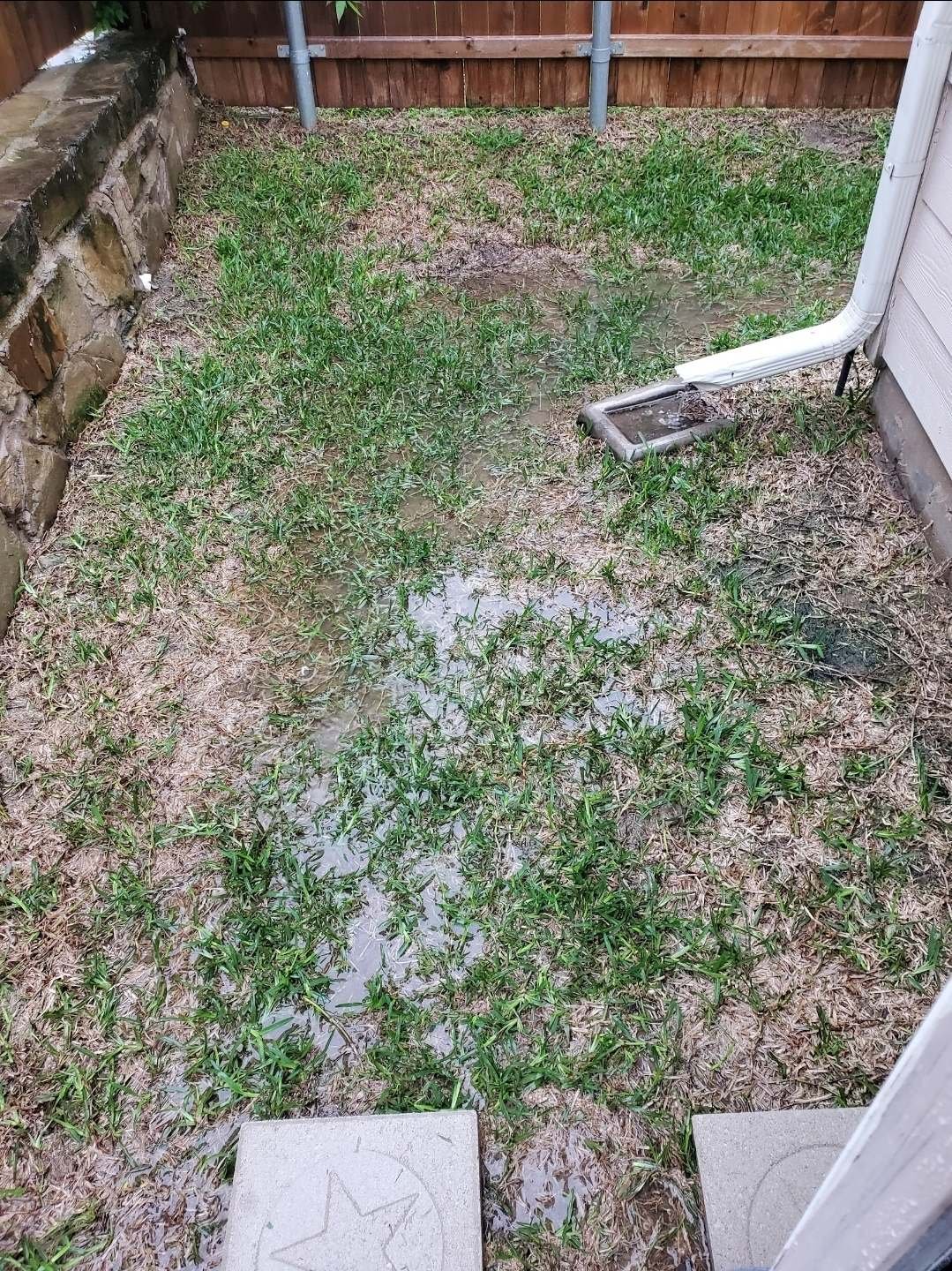
This is the problem: the back yard — the space that later got the turf — photographed after an ordinary rain. Not a flood, not a named storm — just rain. Water standing in the low ground, grass thinned down to mud in the traffic areas, and a splash block doing what splash blocks do, which is move water about eighteen inches from the house and then abandon it.
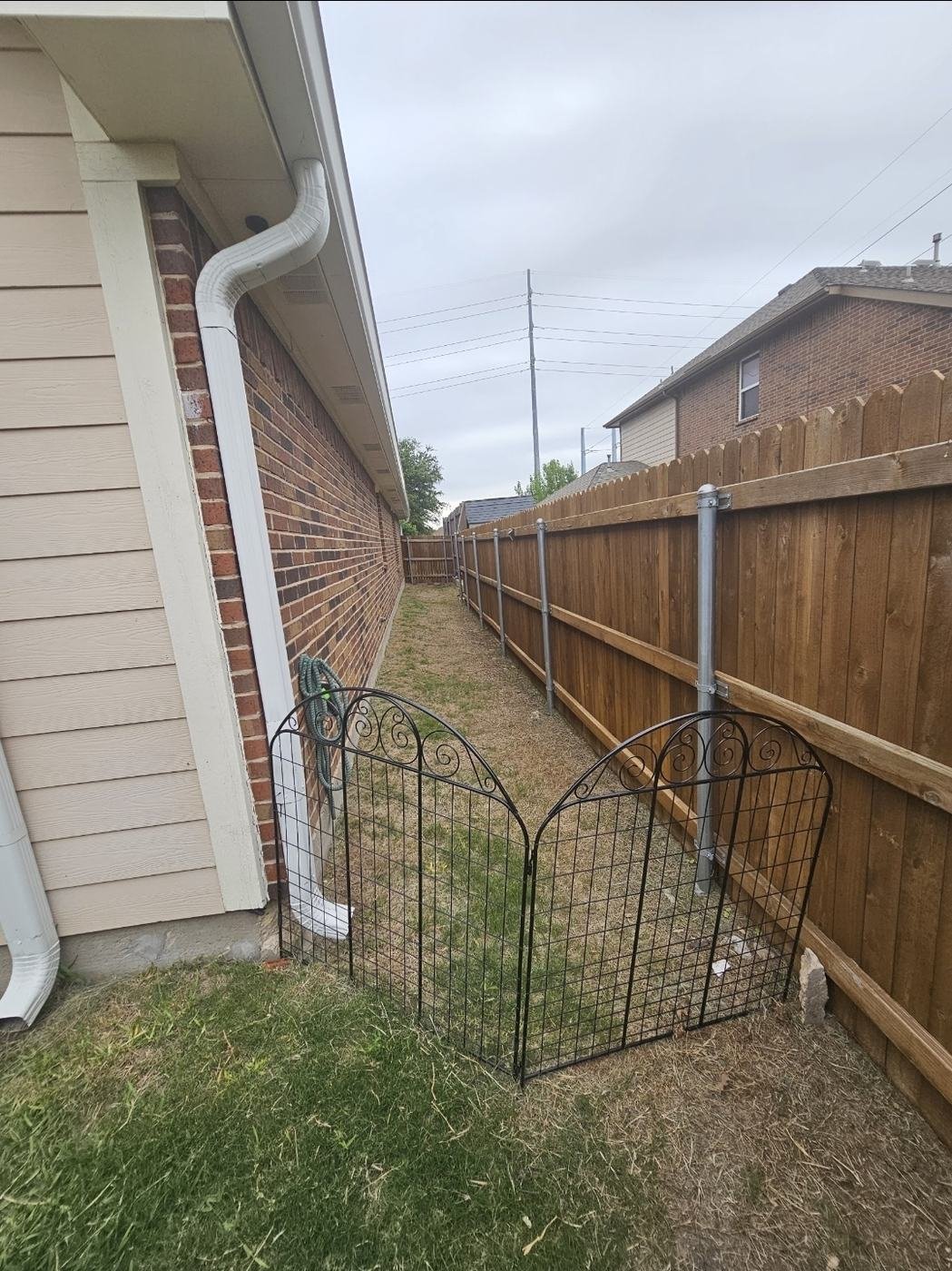
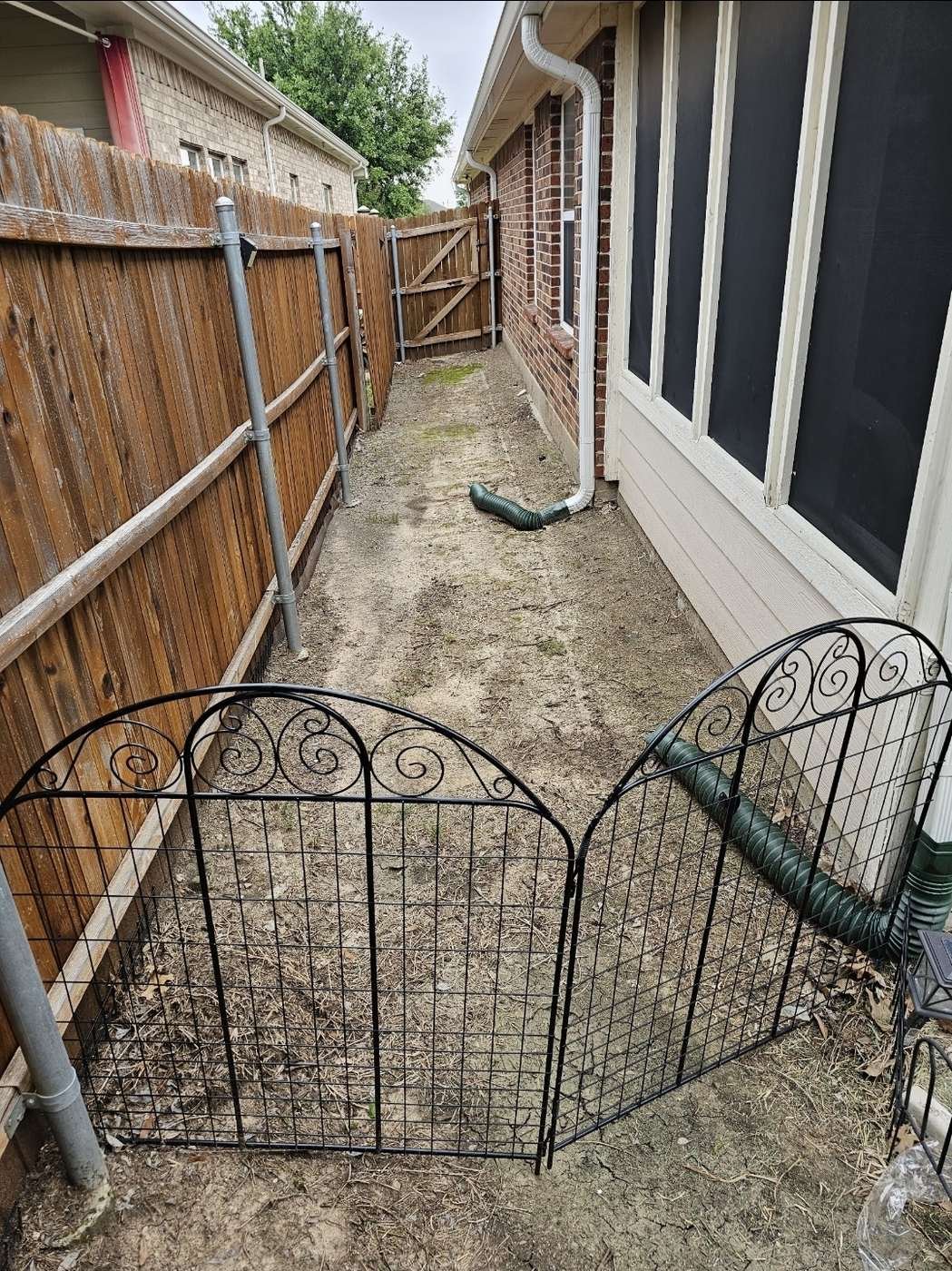
The side yard is the narrow run between the house wall and the neighbour’s fence. It is maybe five feet wide. Nothing grew there, the dirt was compacted hard, and every downspout on that elevation emptied onto it at grade. Security camera footage dates this condition to late November 2023, so this was not a one-off bad week; it was the normal state of the yard.
Two things are worth naming here, because they are the actual diagnosis:
The ground had nowhere to send water. A narrow side yard between a slab and a fence line is often close to flat, and sometimes pitched slightly the wrong way. Water that lands there has no fall to follow, so it sits until it evaporates or soaks in. In North Texas clay, it mostly sits.
The downspouts were making it worse on purpose. Every square foot of roof drains to a downspout. Dumping that volume at the foundation, in the narrowest and flattest part of the yard, concentrates the roof’s entire catchment into the one place least able to handle it.
The dig
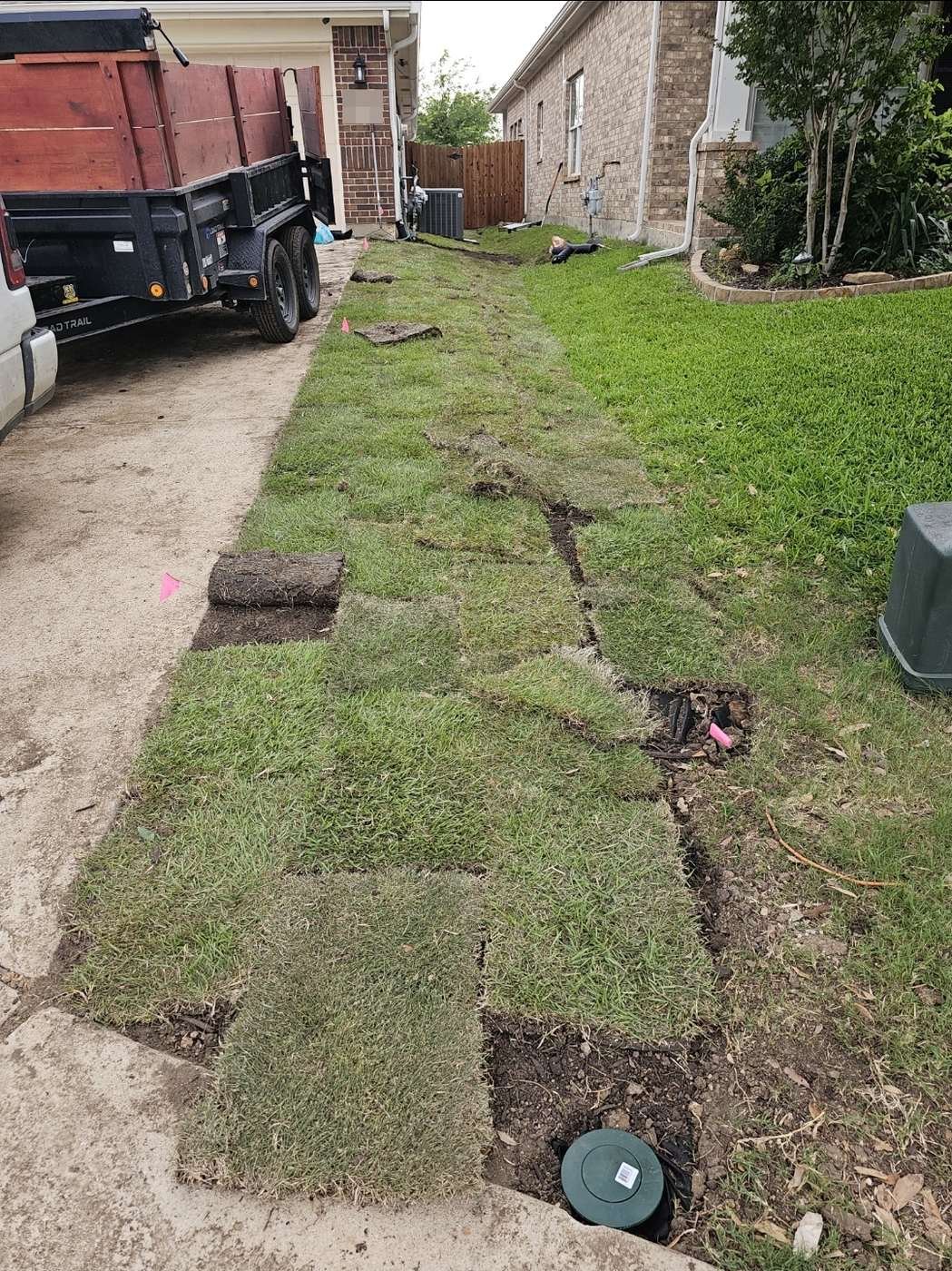
Marking flags first, then a trench. The sod was cut and laid back in flaps along the line rather than scraped off, which is worth noticing — it meant the lawn could be put back the same day instead of reseeded.
The flags matter more than they look. They are the utility locate — gas, electric and communications lines marked before anyone digs. In Texas this is not optional: under Chapter 251 of the Texas Utilities Code, anyone digging 16 inches or deeper with powered or mechanized equipment (a trencher counts) must notify the one-call system, 811, at least 48 hours before digging, not counting weekends and legal holidays, and no more than 14 days ahead (§251.151; definition of “excavate” in §251.002). The statute has no homeowner exemption. Digging purely by hand falls outside its definition, but the call is free and a drainage trench is exactly deep enough and long enough to find a gas line the hard way — so make it either way. Note what the locate does not cover: your own sprinkler lines and any private lines you installed are yours to find.
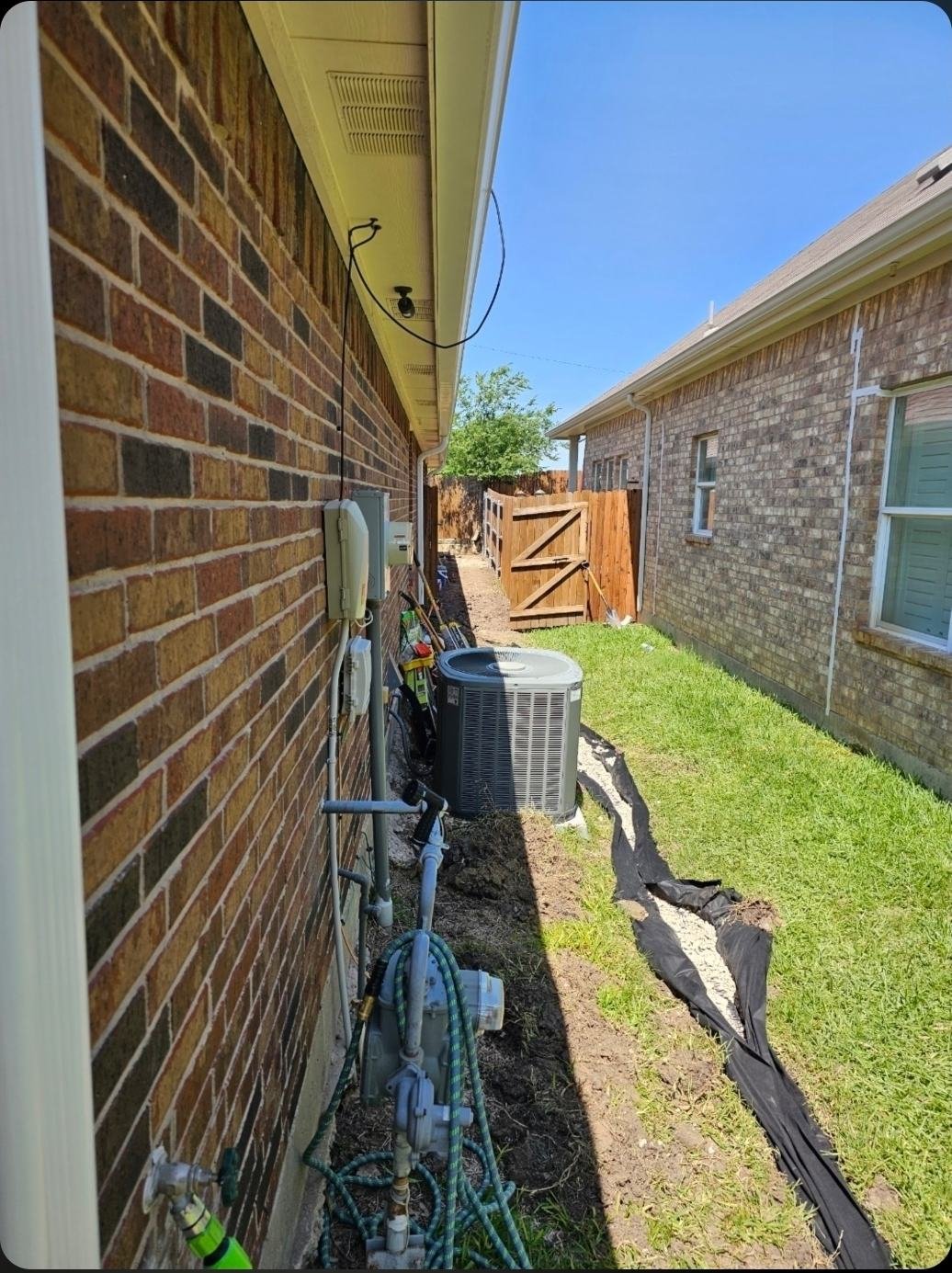
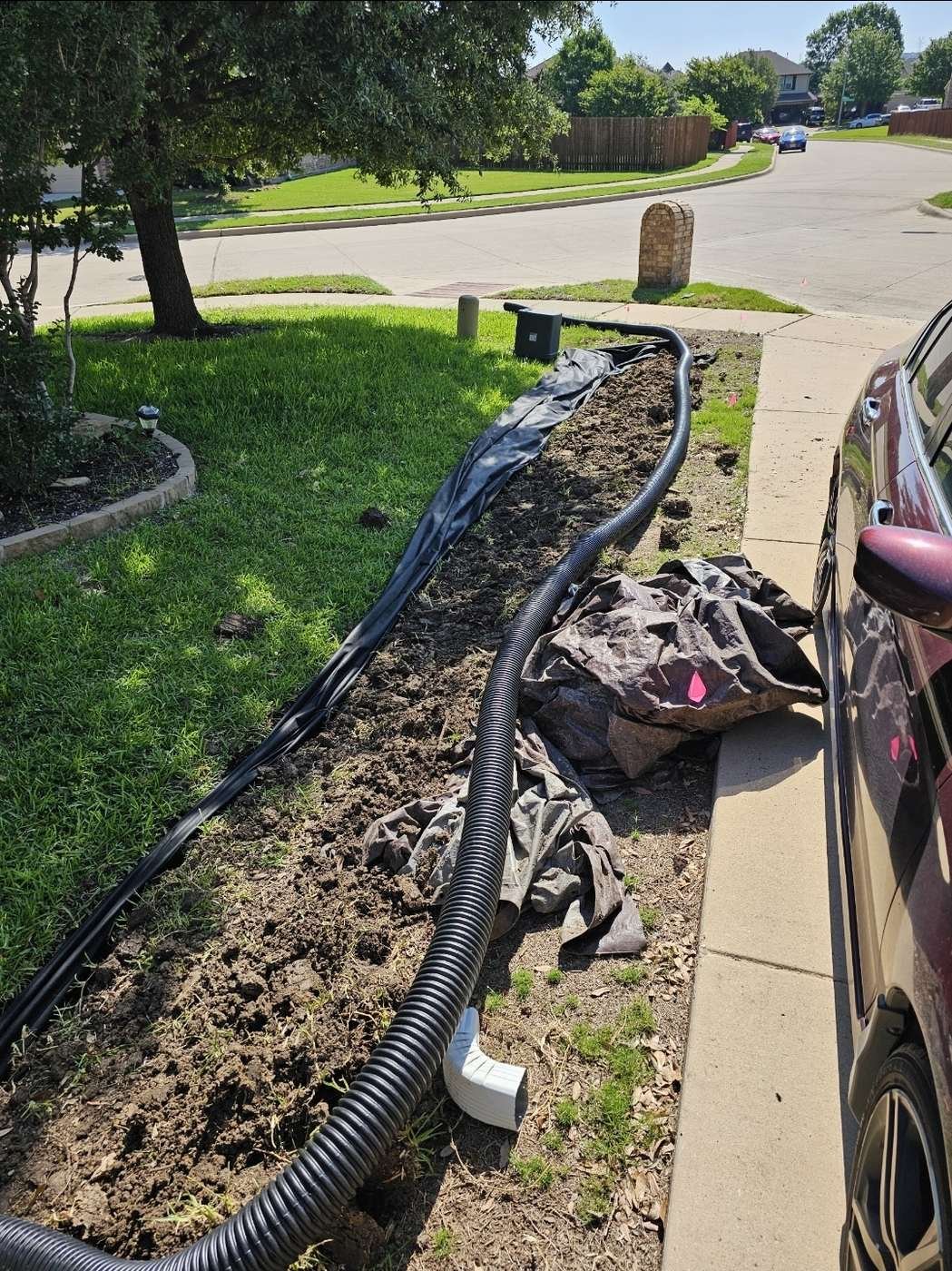
Here is the trench routed past the AC condenser, with filter fabric laid in before the pipe.
The fabric is the part homeowners most often do not know to ask about, and it is the part that decides whether the drain still works in ten years. A French drain fails by silting up: fine clay particles migrate into the gravel, pack the voids, and the whole thing turns into a buried stripe of mud that water runs over instead of into. Fabric lining the trench is what keeps the soil out of the aggregate. A drain installed without it will work beautifully for a season or two and then quietly stop, and you will not be able to tell from the surface that it has.
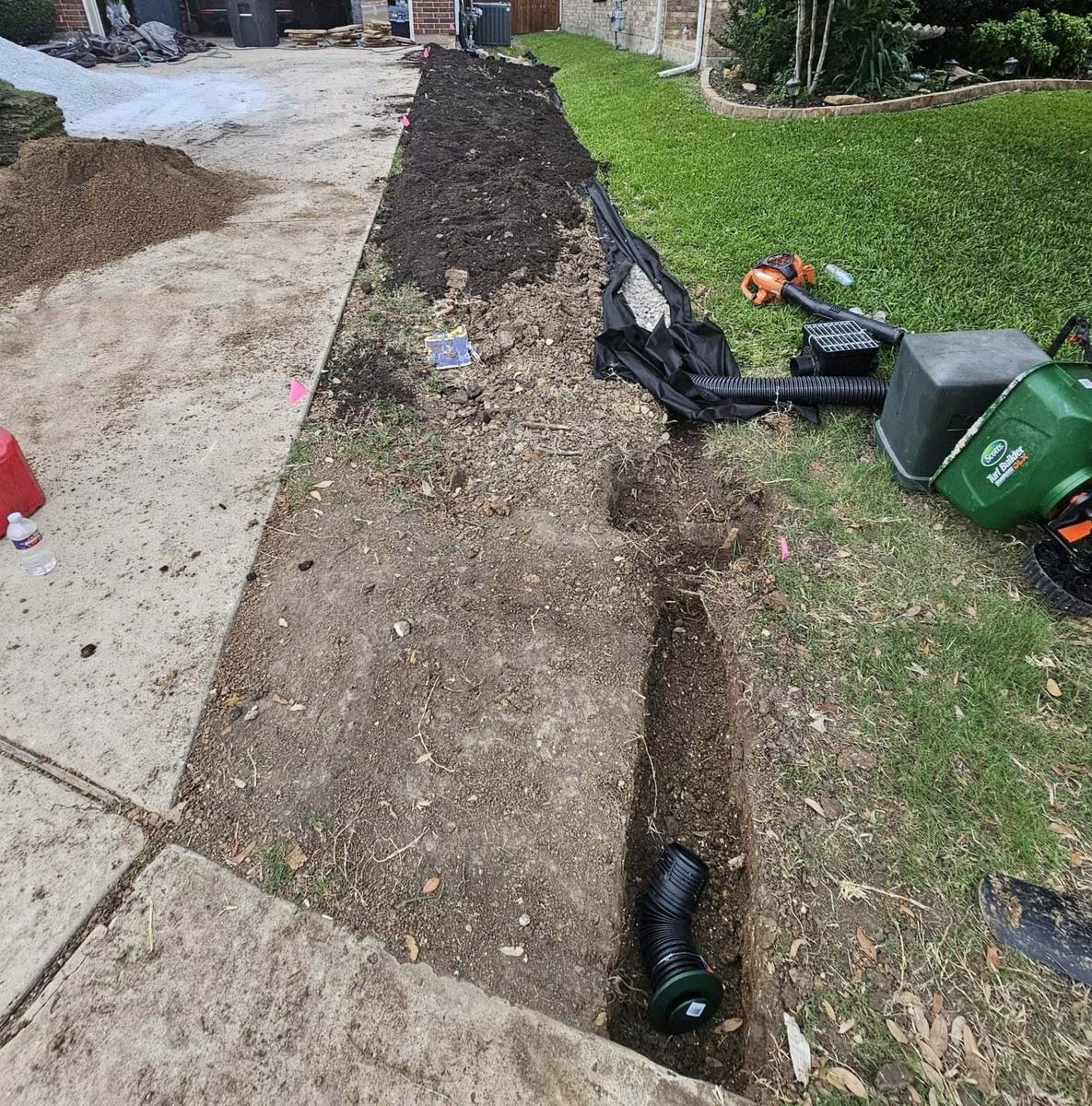
Pipe bedded in gravel in the open trench, before backfill.
Where the water actually goes
This is the section to read if you read nothing else.
The photo at the top of this page is that pipe: leaving the side yard, crossing the entire front lawn, and discharging at the curb. Fabric down, pipe laid, trench still open, flags still in the ground.
A French drain is not a disposal. It does not make water disappear and it does not “drain into the ground” in clay — clay is the reason the water was standing in the first place. A French drain is a route. All it does is collect water at the low point and carry it somewhere lower. If there is no somewhere-lower at the end of it, you have buried an expensive gravel-filled ditch that fills up and backs up.
So the single most important question to ask about any drainage quote is: where does the far end of this pipe come out, and is that point lower than the point it collects from?
Answers that are fine
- Daylight at the curb or into the street gutter, as here. Gravity does all of it, there is nothing to maintain and nothing to fail.
- A pop-up emitter in a lower part of the yard, if the yard genuinely falls that way.
- A sump and pump, if the site has no fall at all — but now you own a pump, and a pump is a thing that fails during the storm you needed it for.
Answers that should stop the conversation
- “It’ll dissipate into the soil.” In heavy clay, largely it will not.
- Into the neighbour’s yard, or onto a downhill property. Texas law is direct about this: “No person may divert or impound the natural flow of surface waters in this state… in a manner that damages the property of another by the overflow of the water diverted or impounded,” and the neighbour whose property is damaged can sue for it (Texas Water Code §11.086). A drain that collects your water and dumps it on the lot next door is exactly that. Ask before, not after.
- No clear answer at all. If the quote does not say where the outlet is, the outlet has not been thought about.
The downspouts, which are half the job — and the cheapest half
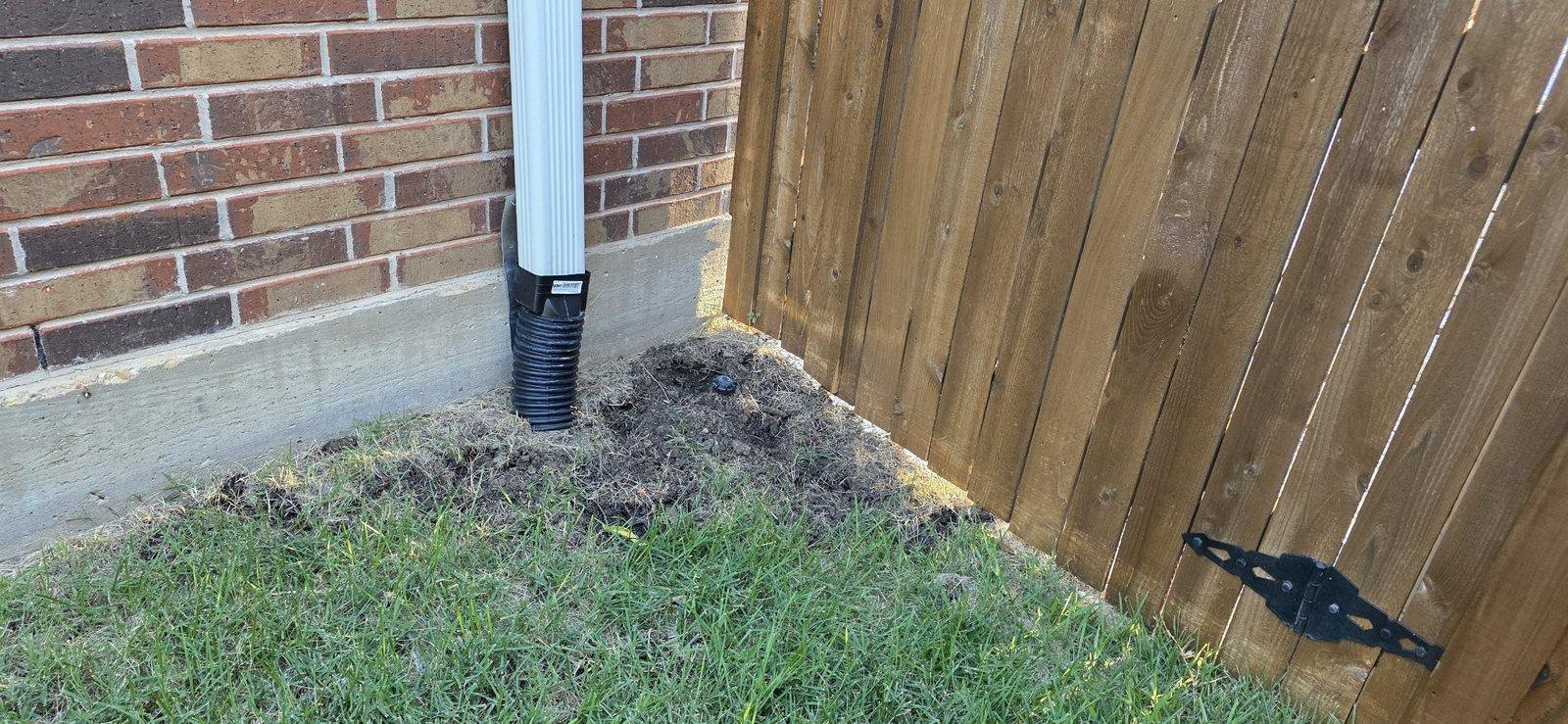
Each downspout on the affected elevations was cut and dropped straight into the buried line instead of onto a splash block.
Worth being precise about what this cost, because it is smaller than people assume. The gutters on this house were already there — seamless gutters had gone in a few months earlier as a separate job. The drainage crew did not touch them. All they did was come to the bottom of the existing downspouts and connect them to the new pipe. That is a connection, not a gutter installation.
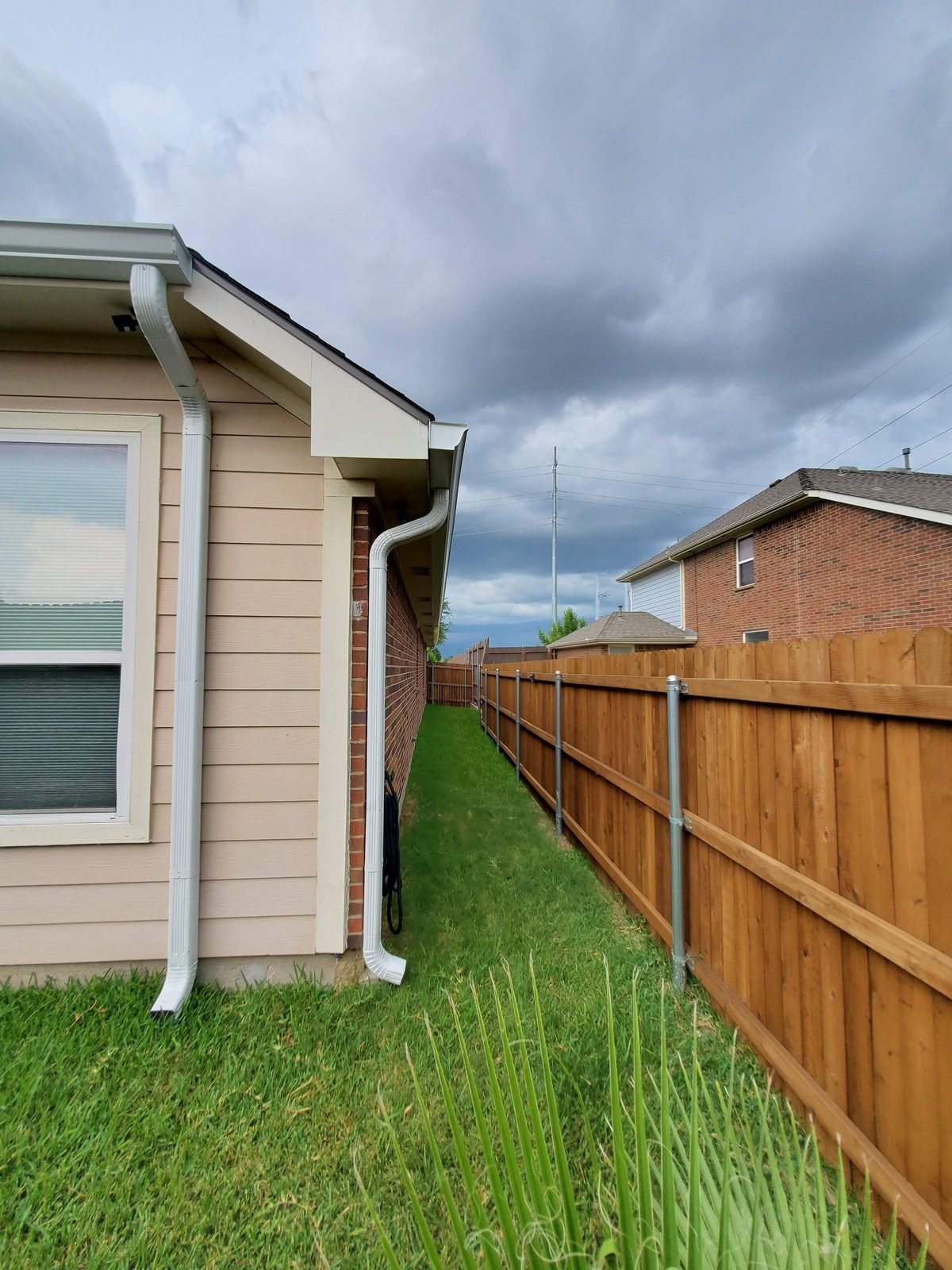
The same downspouts before the tie-in, discharging at grade.
I want to be blunt here, because this is the highest-return part of the whole job and it is routinely skipped: if the downspouts still dump at grade, the drain is fighting the roof. You can install a flawless French drain and still have a wet side yard, because the largest single source of water in that yard is the roof, and you have left it aimed at the foundation.
Which also means this is the part to do first if the budget will not stretch. If you already have gutters, tying their downspouts into even a short run of buried pipe that carries water ten or fifteen feet out from the house is the cheapest meaningful drainage improvement available to most homeowners. It is not a full French drain and it will not fix a yard with no fall. But it removes the roof from the equation, and on a lot of houses the roof was the equation.
Then — and only then — the surface
With the pipe in and working, the surface went back on top.
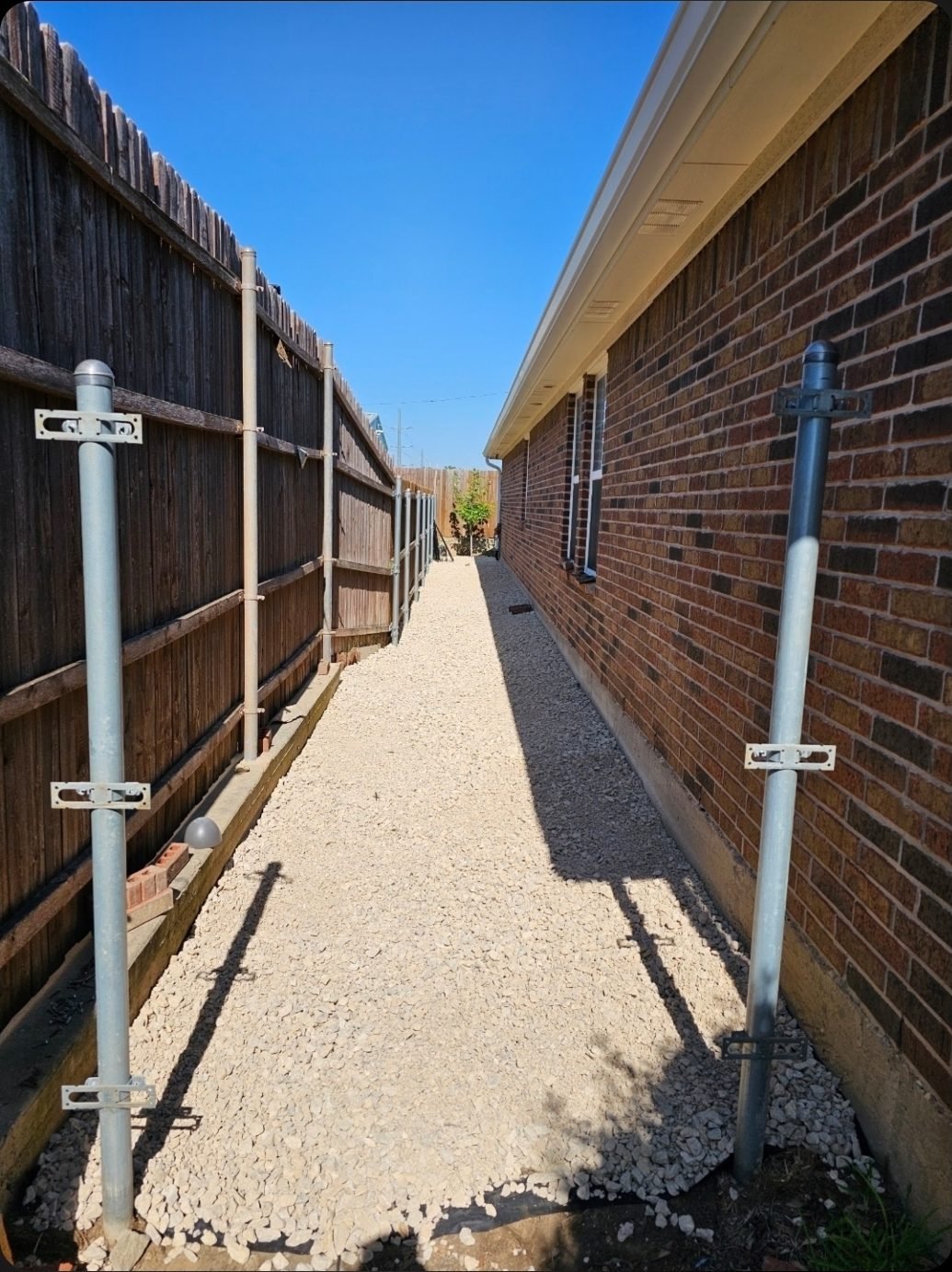
Compacted base over the drain line in the side yard.
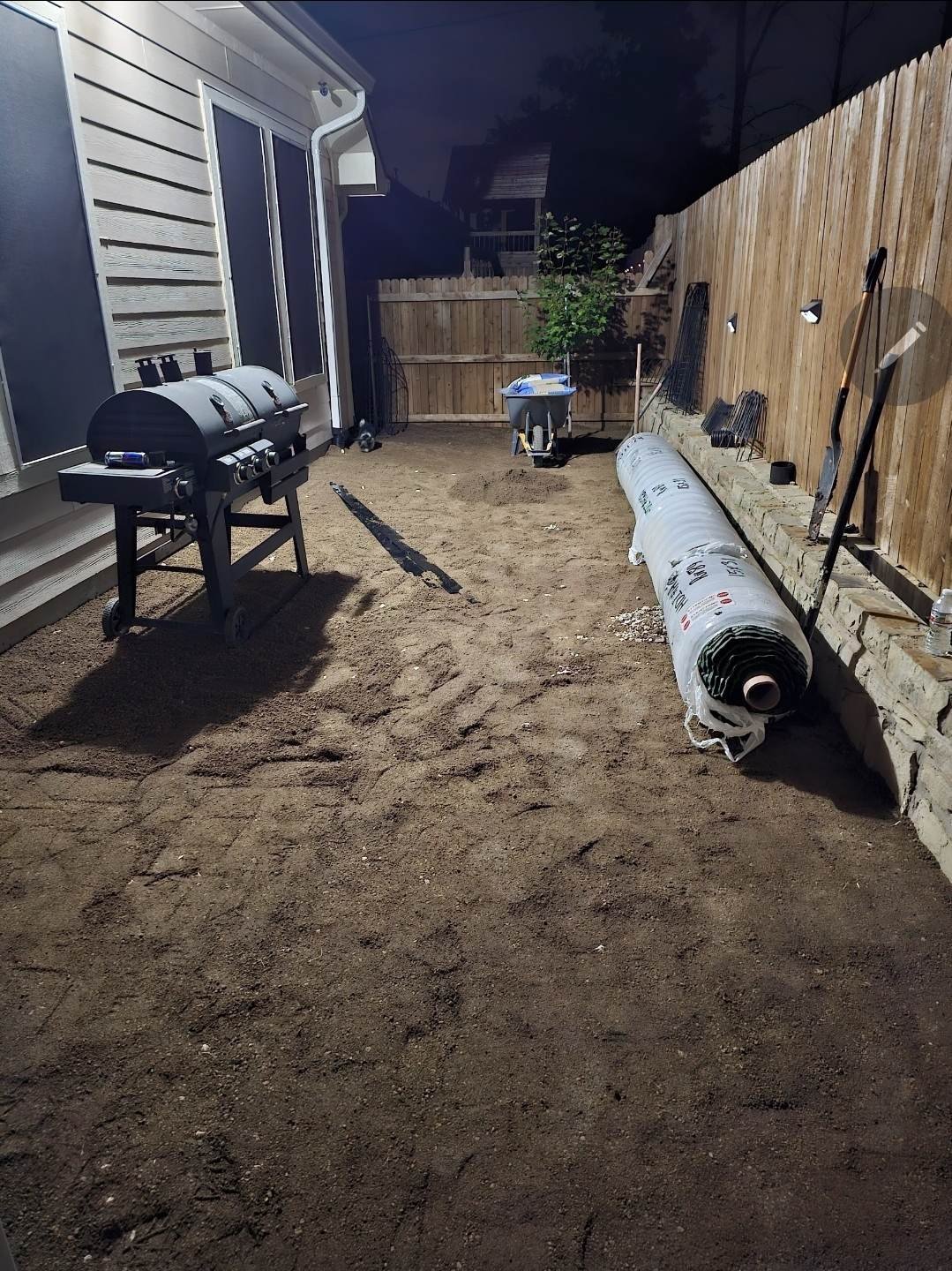
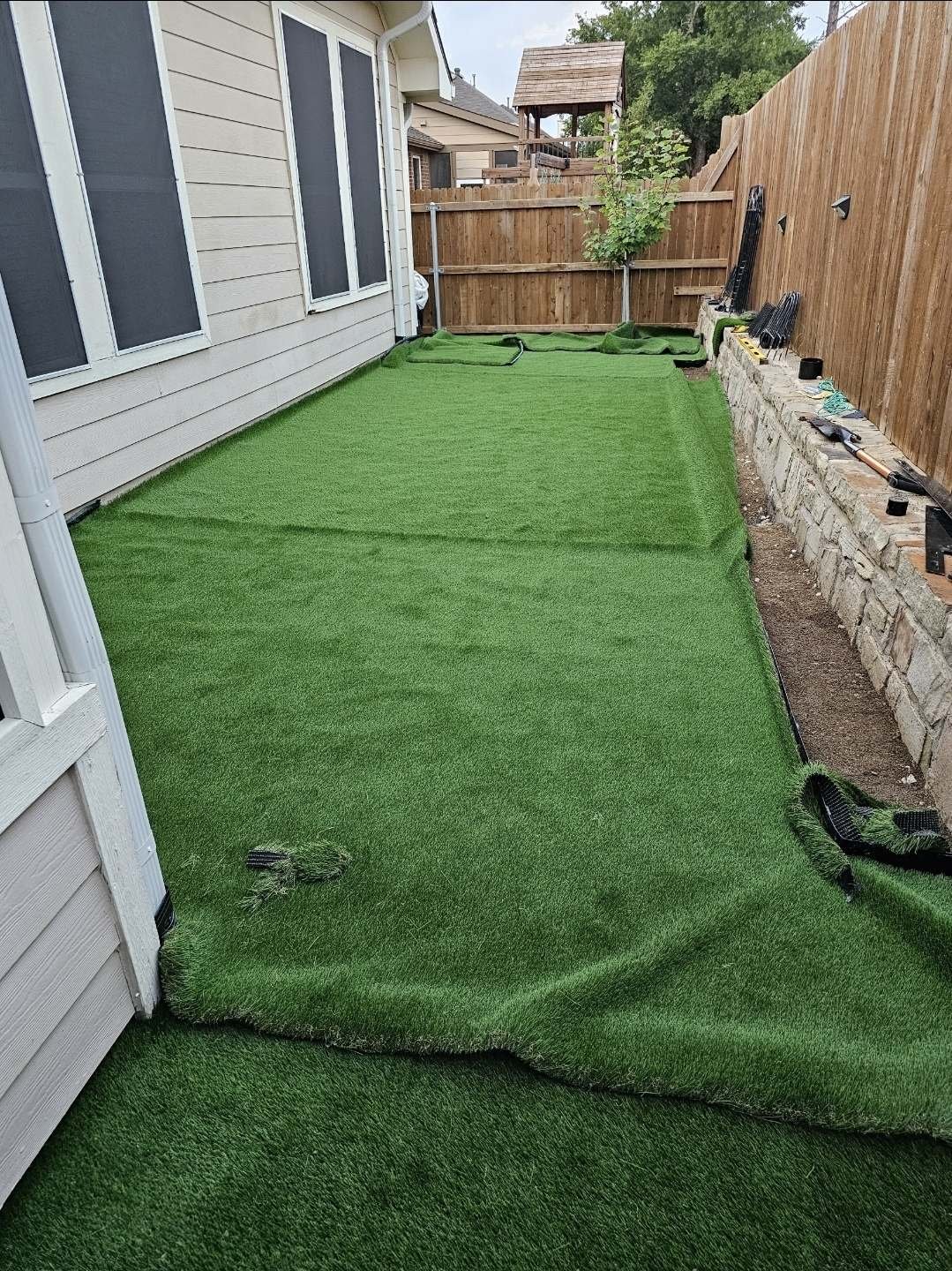
And in the back yard, graded base, then turf rolled over it.
Note the order, because it is the argument of this entire page. The base course is graded after the drain is in and before the surface goes down. The turf is the last thing that happens. It is a finish, like paint. Nobody thinks paint waterproofs a wall.
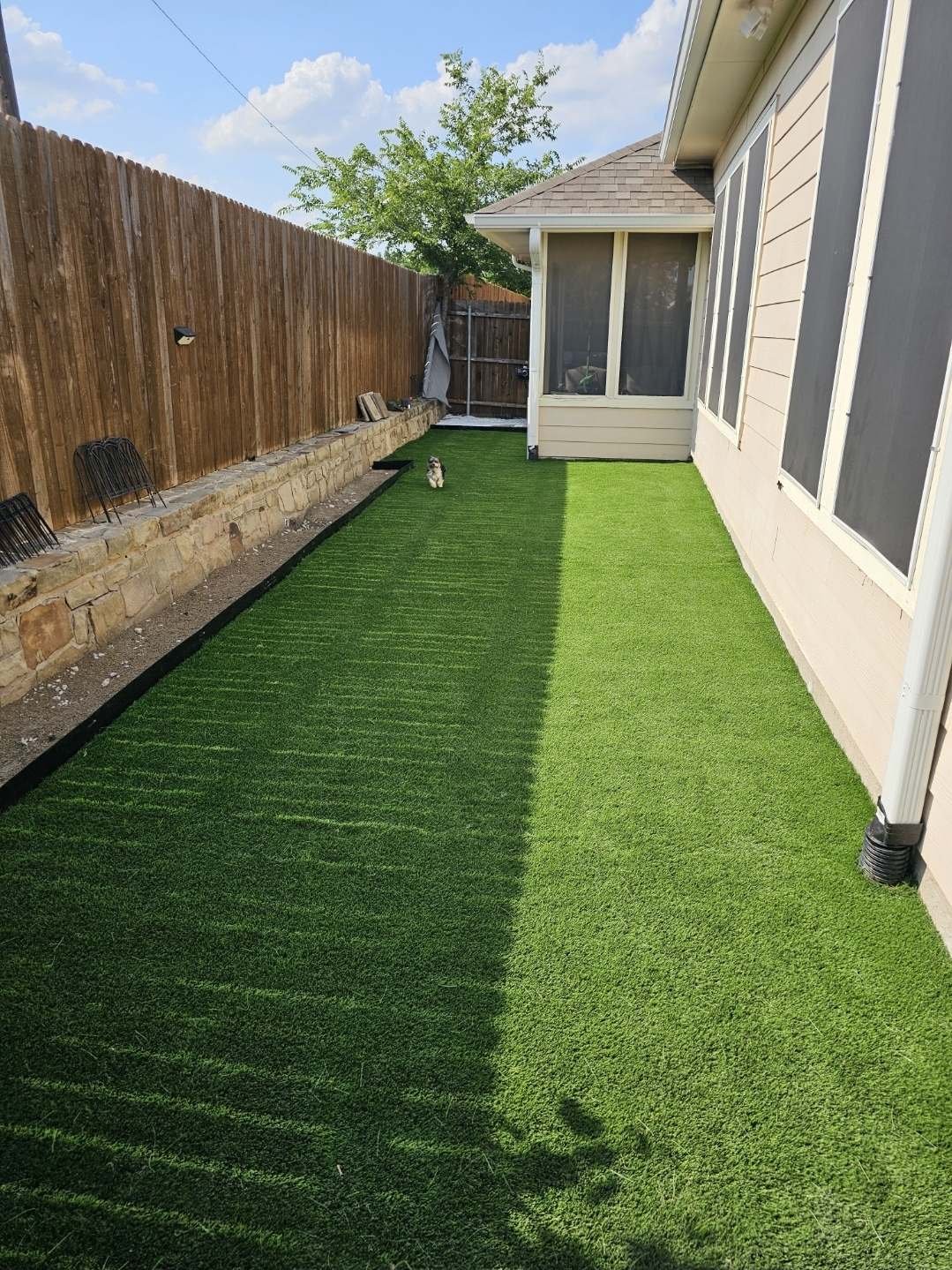
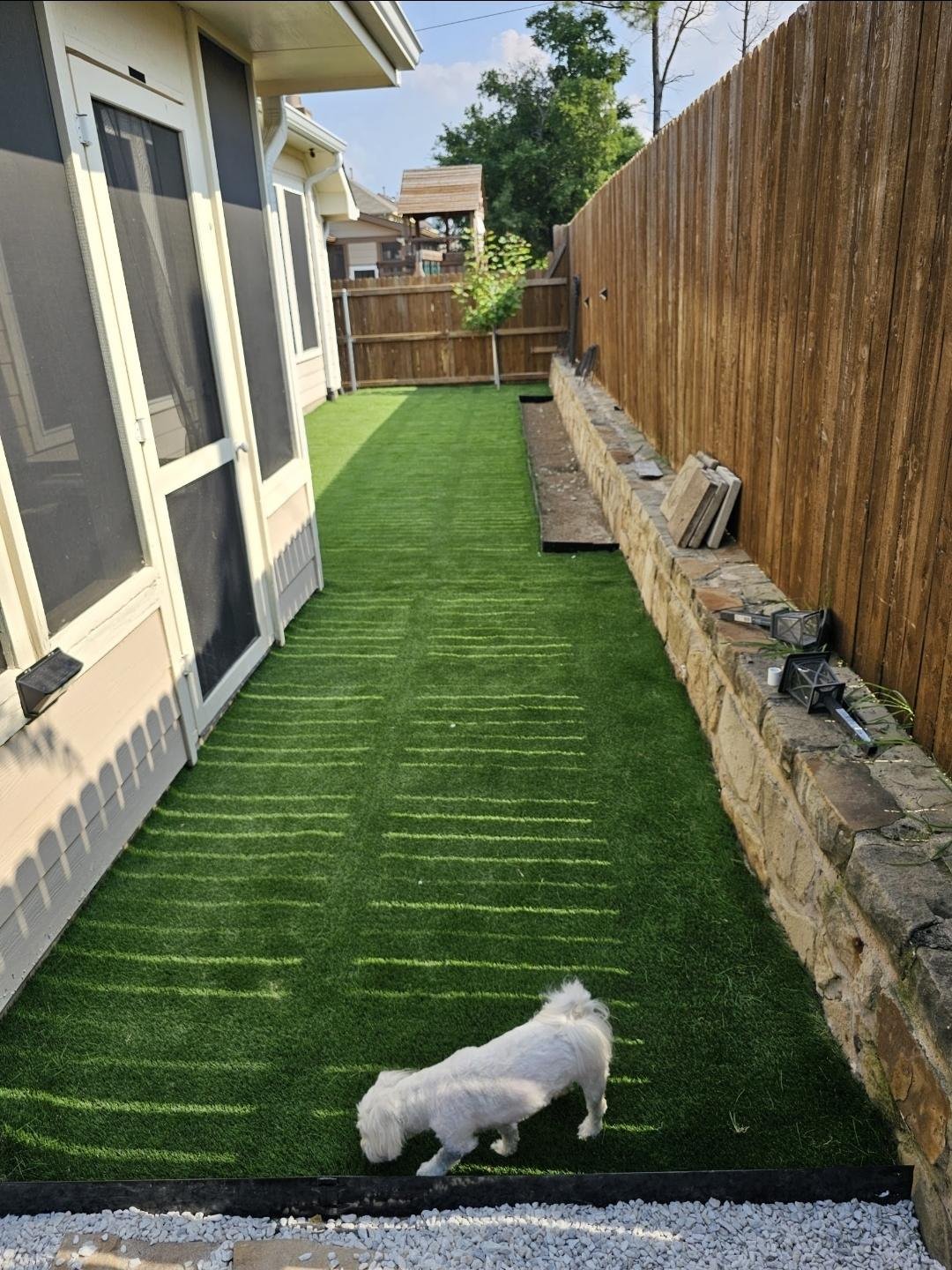
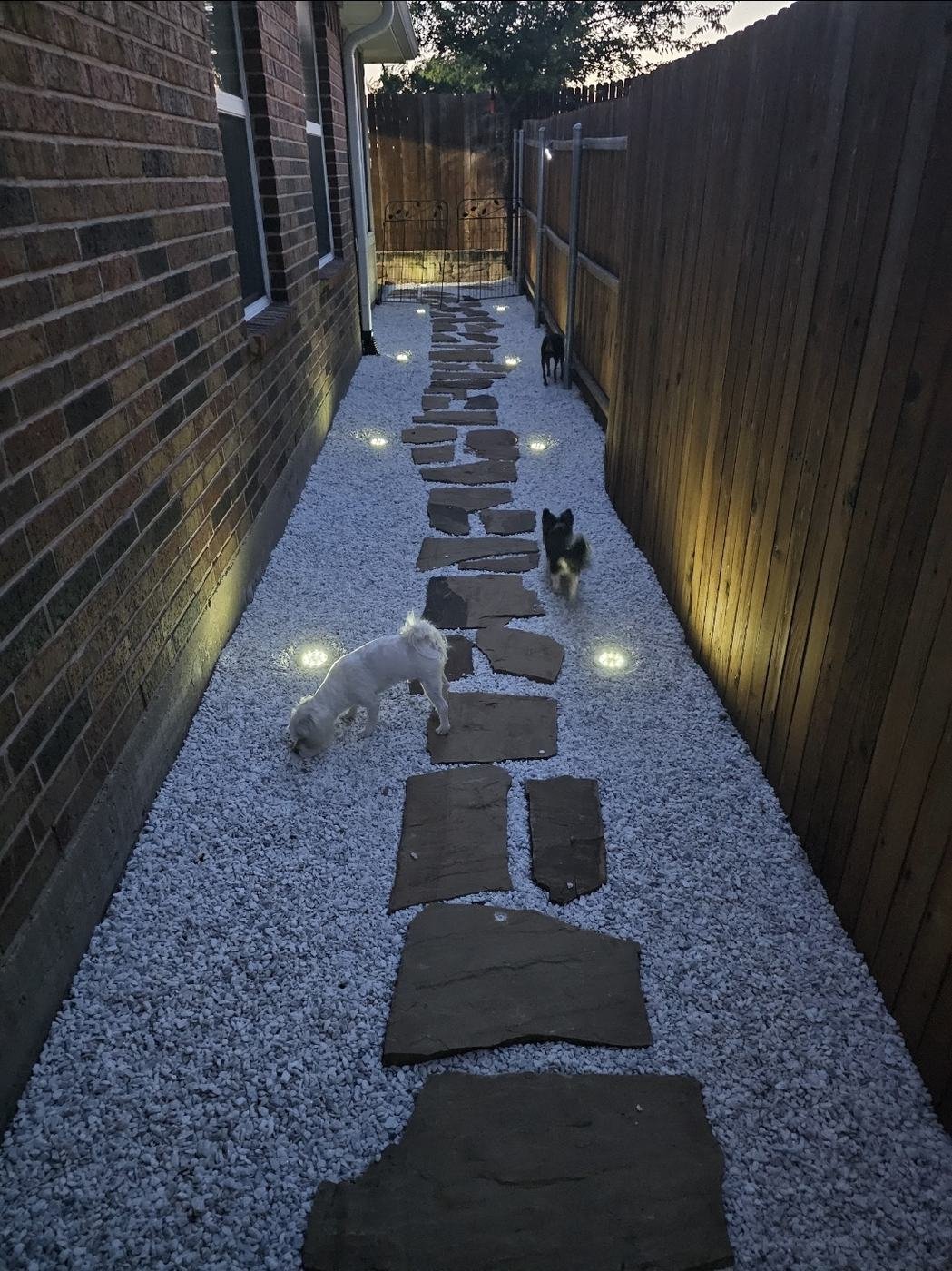
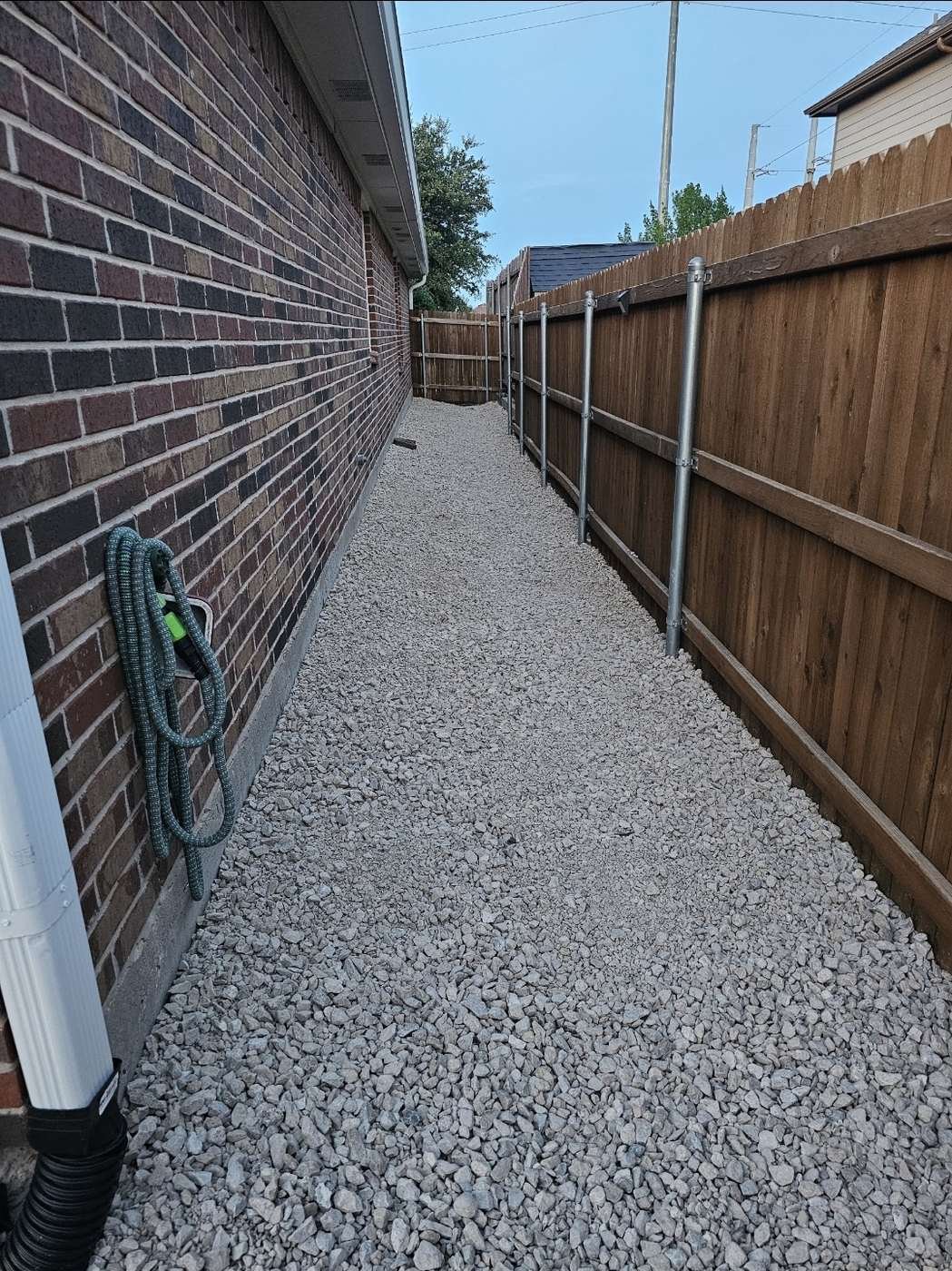
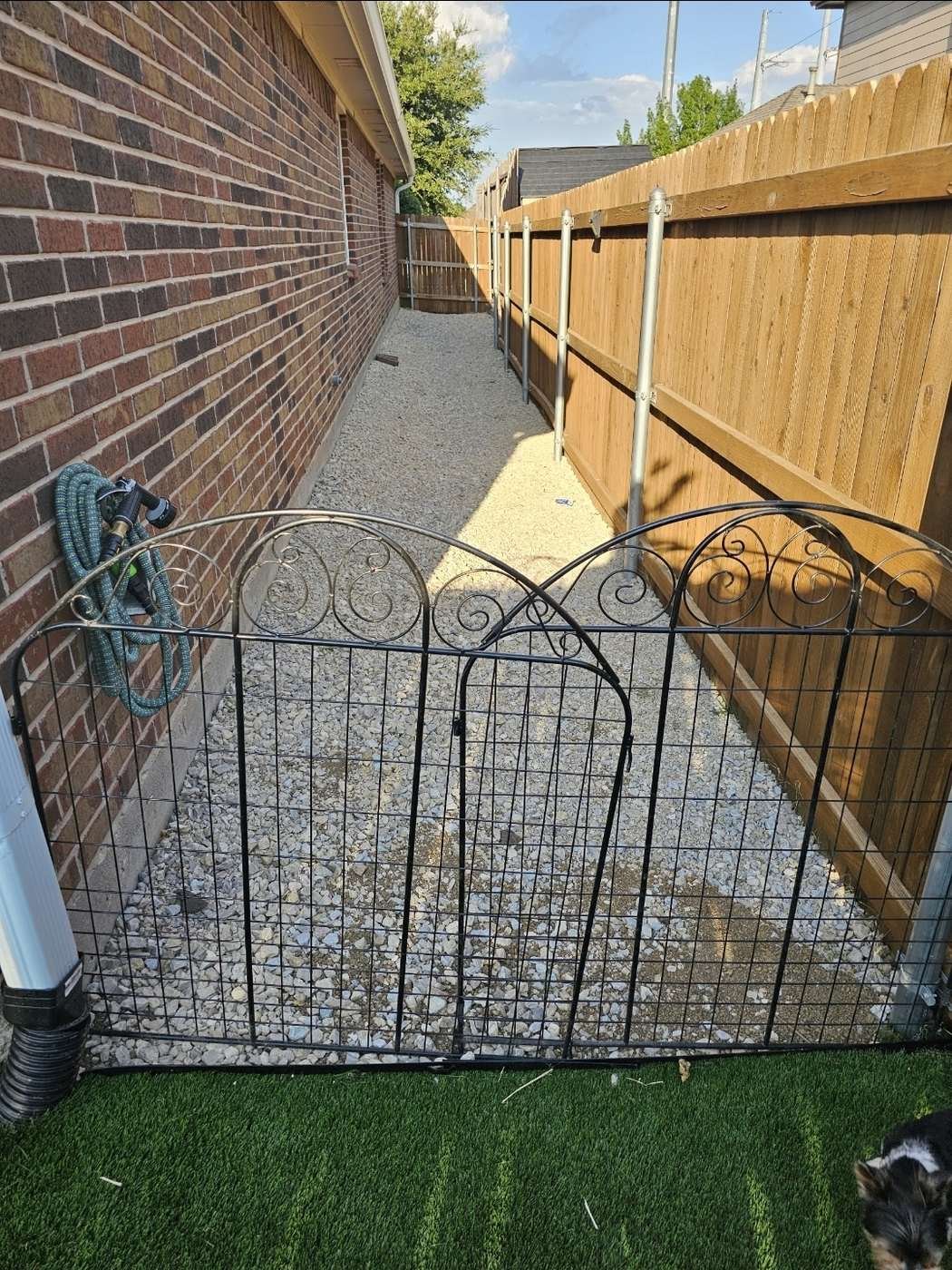
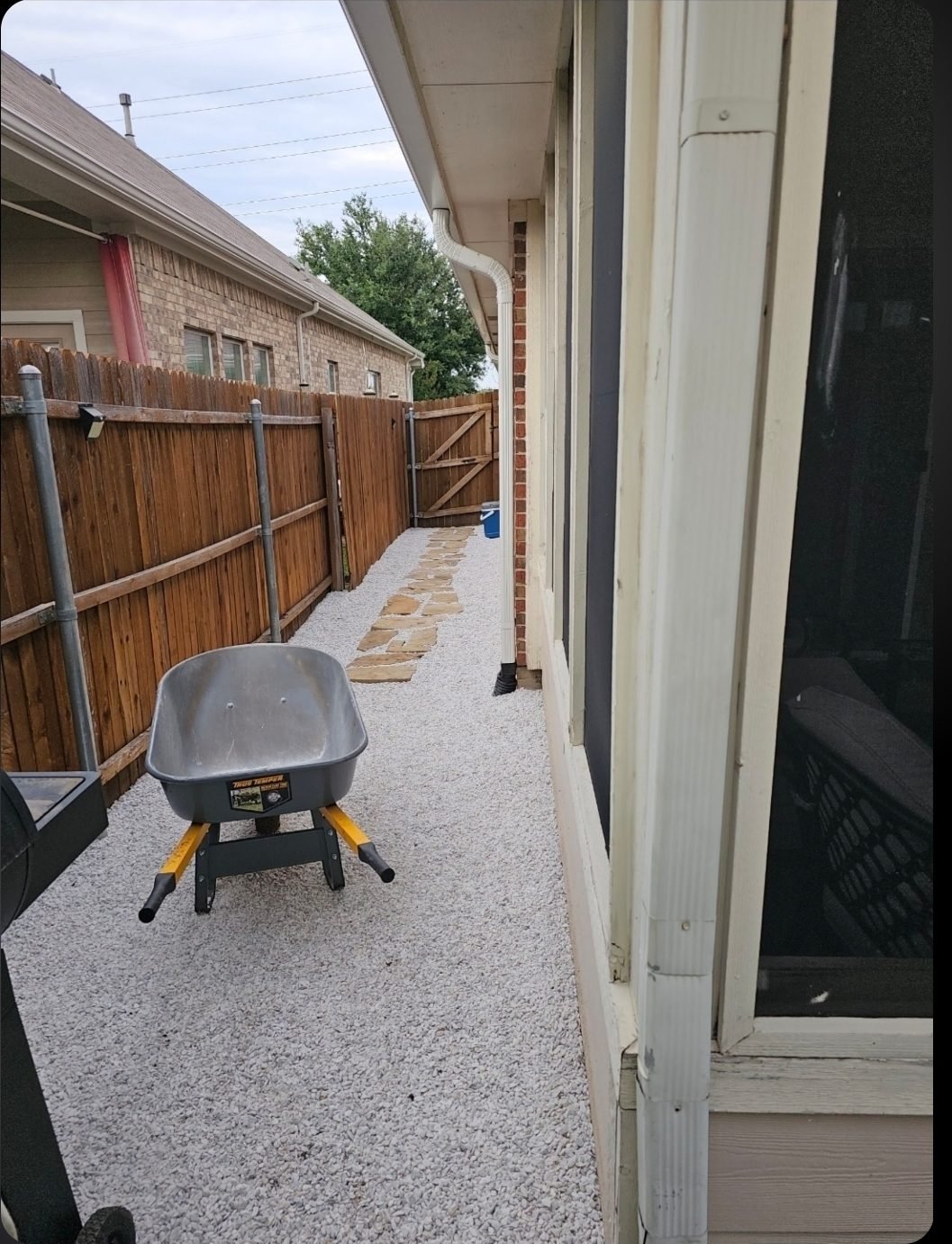
The back yard in turf; the side yard in gravel with a flagstone path and low path lights. Two completely different surfaces, sitting on the same drainage work.
That is the cleanest evidence available that the surface is not what fixed it. If turf were the fix, the gravel side would still be wet. It isn’t.
What it looks like now
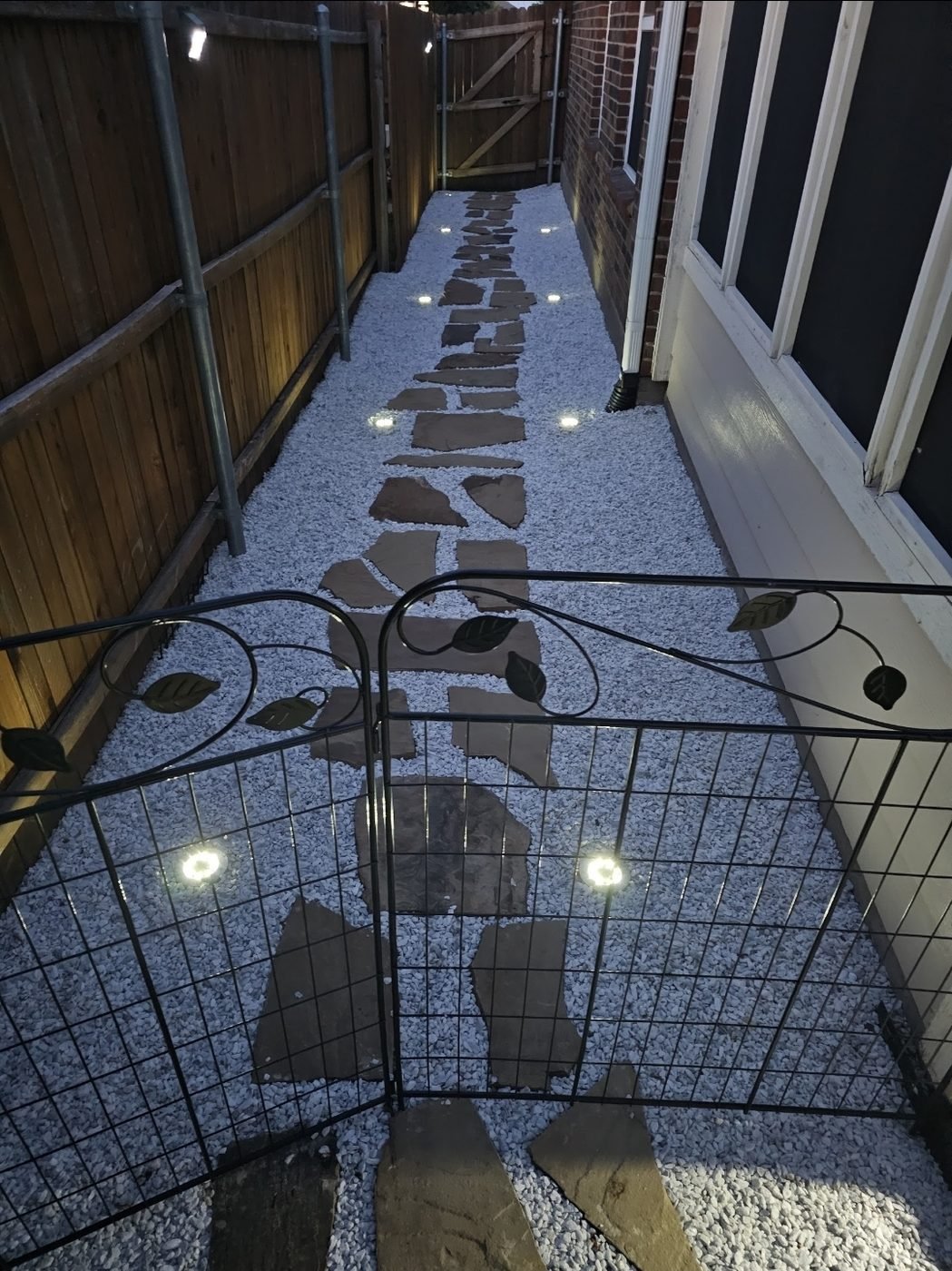
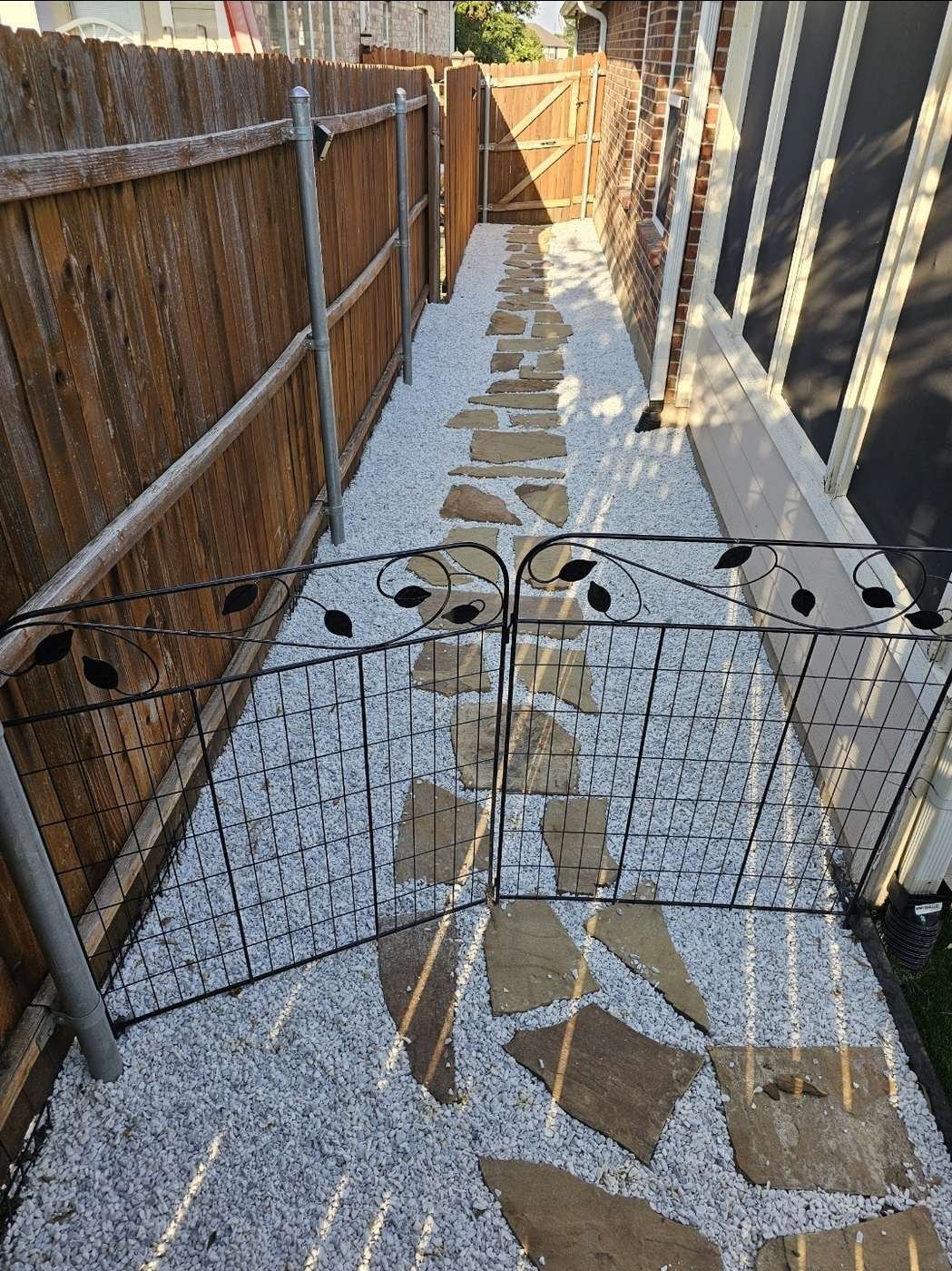
To be straight about these two: they are not storm photos. They are the finished side yard, at dusk and in afternoon sun. The proof that the drainage works is less photogenic than a picture can show — the low ground that used to hold water for days after an ordinary rain doesn’t any more.
The honest version of this result: the water is not gone, it is routed. It fell on the same roof and the same ground as before. The difference is that it now has somewhere to be, and the route is a pipe to the curb rather than a low spot by the foundation.
So: does artificial turf fix drainage?
Laid on ground that already drains, artificial turf is neutral to slightly positive. The backing is permeable, the base course under it is usually crushed and compacted aggregate, and that base is often more permeable than the compacted clay it replaced. You also stop having a mud problem, which is not nothing if you have dogs or kids.
Laid on ground that does not drain, artificial turf is neutral to slightly negative, and it costs you the ability to see the problem. Water that used to pool visibly now sits in the base layer under a mat. In practice that shows up as a yard that smells after rain, stays spongy underfoot for days, and — if it is against the house — keeps a wet zone in permanent contact with the foundation. In expansive clay, a permanently wet zone against one side of a slab while the other side dries is the differential moisture condition that moves foundations. Our foundation repair cost guide covers what that costs to correct, and it is an order of magnitude more than drainage.
So the real answer is that turf is a surface decision, not a water decision. Decide the water first.
What to check before you sign a drainage bid
Pulled from this job, in the order I would ask them:
- Where does the outlet daylight, and is it lower than the collection point? Get it in writing. If the answer is vague, nothing else on the quote matters.
- Is filter fabric included, and lining the trench — not just laid over the top? This decides whether the drain lasts ten years or two seasons.
- Are the downspouts being tied in? If not, ask what the plan is for the roof water, because the roof is the biggest contributor.
- Who calls 811, and when? It should be them, at least 48 hours before they dig (weekends and holidays don’t count), and the flags should be in the ground before the trencher arrives.
- Does the outlet put water onto anyone else’s property? Ask this out loud before work starts — under §11.086 it is the property owner who answers for it afterwards, not just the contractor. If the outlet goes through the curb, also ask whether your city requires a permit for that.
- What happens to the sod and the irrigation? Cut-and-lay-back versus strip-and-reseed is a real difference in how the yard looks a week later, and trenching through an irrigation zone without a plan means you find the line by cutting it.
- Is the surface work quoted separately from the drainage work? It should be. They are different jobs, and bundling them makes it easy to pay turf prices for a drainage problem that never got solved.
Where these numbers come from, and what they are not
Written by Jimmy Hall, a Texas homeowner — not a contractor, plumber, electrician or adjuster. Why that matters.
Anything here about Texas law, building code or insurance is cited to a primary source — the statute itself, the Texas Administrative Code rule, the agency that adopted it, or the city’s own permit documents. Not to another blog. Where sources genuinely conflict and no authority settles the question, this site says so plainly rather than picking one and sounding certain.
Reviewed September 2026. Texas changes on a fixed schedule — building codes and new laws take effect on September 1, and tax credits change with the calendar year — so these pages are re-checked at least twice a year, and sooner when something we track moves. How we research prices and rules.
How this site makes money. Some outbound links are affiliate links and we may earn a commission if you use one. That has no bearing on the figures above, and nothing here is a paid placement. We do not sell repairs, we do not sell your details to contractors, and there is no lead form on this page.
Think something here is wrong? Tell us — especially if you do this work for a living. A correction that comes with a source gets made.
Every photograph on this page is of one house in the Dallas–Fort Worth area, taken by the homeowner during the actual work. Nothing here is stock. A visible house number has been obscured, and the installer’s branding has been obscured on one photograph; nothing else has been altered. Two photographs used elsewhere on this site to show water pooling against a foundation are of a different property and are not part of this job.
This page deliberately does not give a price for the work shown. Drainage cost depends almost entirely on linear footage, trench depth, how far the outlet is from the collection point, and what the trench has to route around — which means a number from one yard tells you very little about yours. If you want to compare a bid against something, compare the questions above, not a dollar figure.