
Gutter Installation & Repair Cost in Texas
Seamless aluminum gutters run $6 to $13 per linear foot installed in Texas, which puts most whole-house jobs between $1,600 and $5,000 depending on home size, gutter size and roof complexity. Small homes can come in near $800. Steel and copper systems run $2,500 to $6,000 and up.
That is the easy part. The harder question is what the gutters are for, and in Texas the honest answer is not curb appeal or a dry front step. On expansive clay soil, gutters are foundation equipment — and most of the systems on Texas houses are undersized for the storms we actually get and dump their water in exactly the wrong place.
Start here if…
- You’re pricing new seamless gutters — stay on this guide for 5-inch vs 6-inch, downspout discharge, and DFW storm sizing, then use our tools hub if you want a quick repair-vs-replace frame.
- You’re deciding spot repair vs full replace after a leak or sag — run the repair-or-replace decision tool with the repair quote in hand, then come back for material and foundation-protection notes.
- You’re not sure where to begin — Start Here orients you across cost guides and tools before you commit to a same-day upsell.
Owned tools and guides only — we don’t broker gutter jobs or sell your phone number.
The Short Version
- Seamless aluminum installed: $6–$13 per linear foot; $10–$20 nationally for aluminum generally
- Whole house: roughly $1,600–$3,300 at 130 ft, $2,400–$5,000 at 200 ft
- Downspouts: $30–$75 each installed
- Upgrading 5-inch to 6-inch: about $1–$2 more per foot, and worth it on most Texas roofs
- Gutter guards: $15–$45 per linear foot installed — often the most oversold item in the trade
- Old gutter removal: $50–$200
- Downspouts should discharge 5 to 10 feet from the foundation — 7 to 10 in clay soil
Estimate Your Gutter Cost
Gutter pricing is driven by linear feet, gutter size, number of downspouts and how many stories the crew has to work from. Use the calculator for a starting number, then read the sizing section — it is the part that decides whether the system actually works.
Cost by Material
| Material | Installed cost per linear foot | Notes |
|---|---|---|
| Vinyl / PVC | $8–$12 | Cheapest, but Texas UV makes it brittle. Fine for a shed, not a house |
| Aluminum | $10–$20 | The default. Seamless adds $3–$5+ per foot over sectional and is worth it |
| Steel | $10–$35 | Stronger, heavier, better in hail country. Watch for rust at cut ends |
| Copper | $25–$40+ | Architectural choice. Beautiful, expensive, and a theft target |
Free: the Texas contractor bid checklist
Three printable pages: what a fair bid has to spell out, the red flags, and a worksheet for deciding whether a hail claim is worth filing. Download the PDF — no email needed.
Want a short email when Texas prices, codes or insurance rules change? Leave your address. No spam, we never sell your details, and you can unsubscribe any time.
For nearly every Texas home the right answer is seamless aluminum, formed on site so there are no lap joints to leak. The upgrade decision worth arguing about is not the metal — it is the size.
Cost by Home Size
| Home size | Approximate linear feet | Installed total |
|---|---|---|
| ~1,000 sq ft | 130 ft | $1,600–$3,300 |
| ~2,000 sq ft | 180 ft | $2,200–$4,500 |
| ~2,500 sq ft | 200 ft | $2,400–$5,000 |
Two-story homes, steep pitches, and roofs with lots of valleys and dormers push these higher, because the crew spends more time on ladders and the runs get broken into more sections.
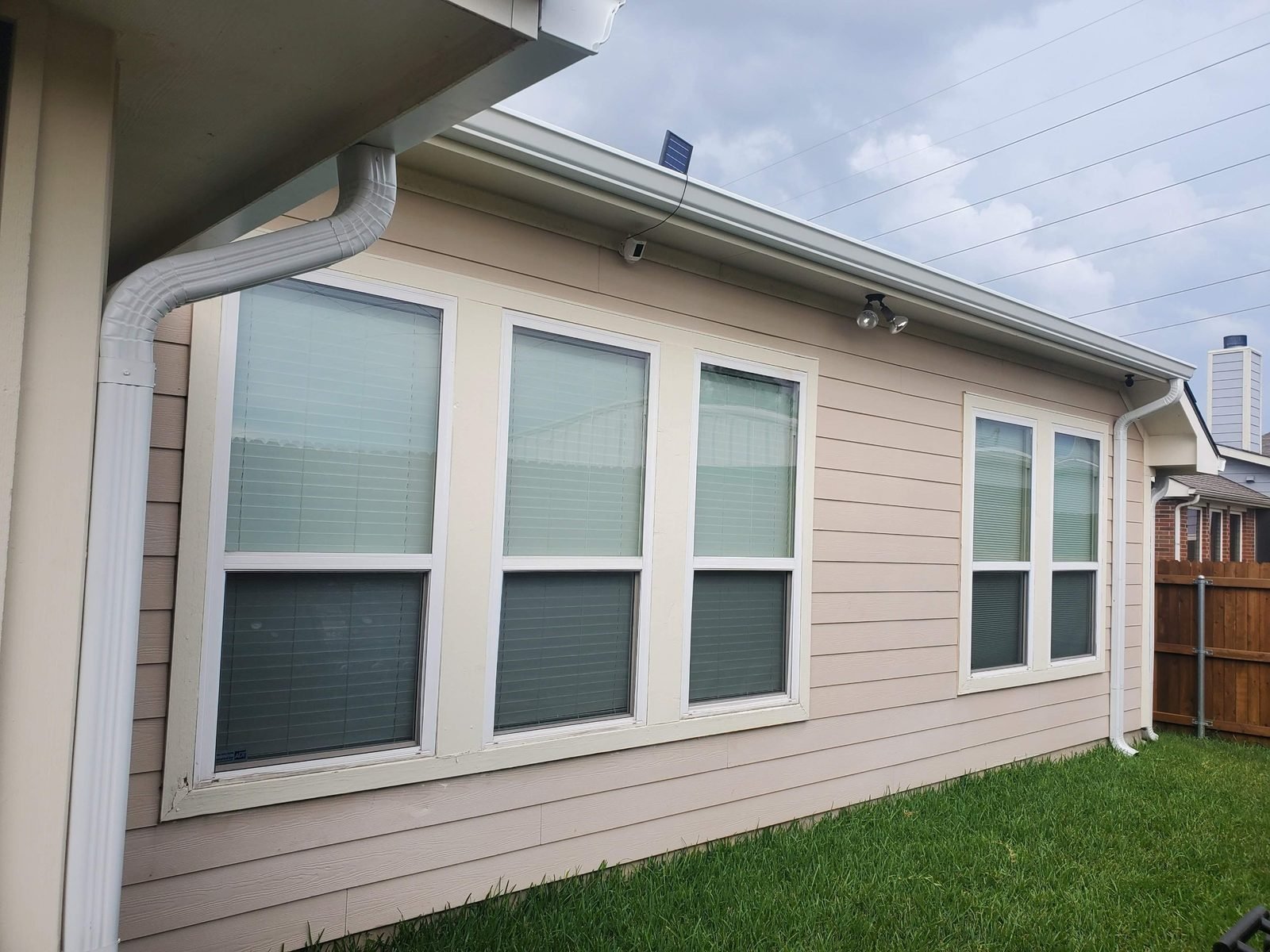
5-Inch vs 6-Inch: The Decision Most Texas Homeowners Get Wrong
Five-inch K-style is the residential default across the country. It was sized for ordinary rain. Texas storms are not ordinary rain — they are short, violent, and they deliver more water in twenty minutes than many climates see in a day.
The industry benchmark for sizing is a 4-inch-per-hour rainfall intensity. At that rate, using SMACNA reference figures, a 5-inch K-style gutter drains about 5,520 square feet of roof area, while a 6-inch drains about 7,960 — roughly 44 percent more capacity. Per foot of gutter, the 5-inch holds about 1.2 gallons and the 6-inch about 2.0.
Peak short-duration rainfall intensities across much of Texas run at or above that 4-inch-per-hour benchmark, which is why contractors in high-intensity markets default to 6-inch gutters and pair them with larger 3×4 downspouts instead of the standard 2×3. For an extra $1 to $2 a foot, that is one of the better upgrades on this page.
Downspout count matters as much as gutter width. A long run with a single downspout at the far end has to move the entire volume the whole length of the gutter before it can drain, and it overflows at the middle every time. Add intermediate downspouts on long runs and at internal high points rather than accepting the minimum the bid includes.
The symptom of an undersized system is easy to spot: water sheeting over the front edge during a hard rain while the gutter itself is perfectly clean. That is not a clog. That is capacity.
In Texas, Gutters Are Foundation Equipment
North and Central Texas sit on expansive clay. It swells when it gets wet and shrinks when it dries, and a slab foundation riding on it moves with it. The thing that damages foundations here is not moisture — it is uneven moisture, a wet strip of soil on one side of the house and a bone-dry strip on the other.
A roof is a very large funnel. Without gutters, every square foot of it dumps concentrated runoff into a narrow band of soil right at the slab edge, then that band bakes dry during the next three weeks of Texas summer. That cycle, repeated, is the mechanism behind a large share of the foundation repair work in this state — and foundation repair starts around $1,000 per pier and routinely runs $3,300 to $15,000 in DFW.
Against those numbers, a $2,500 gutter system is not a cosmetic purchase. It is the cheapest foundation insurance available.
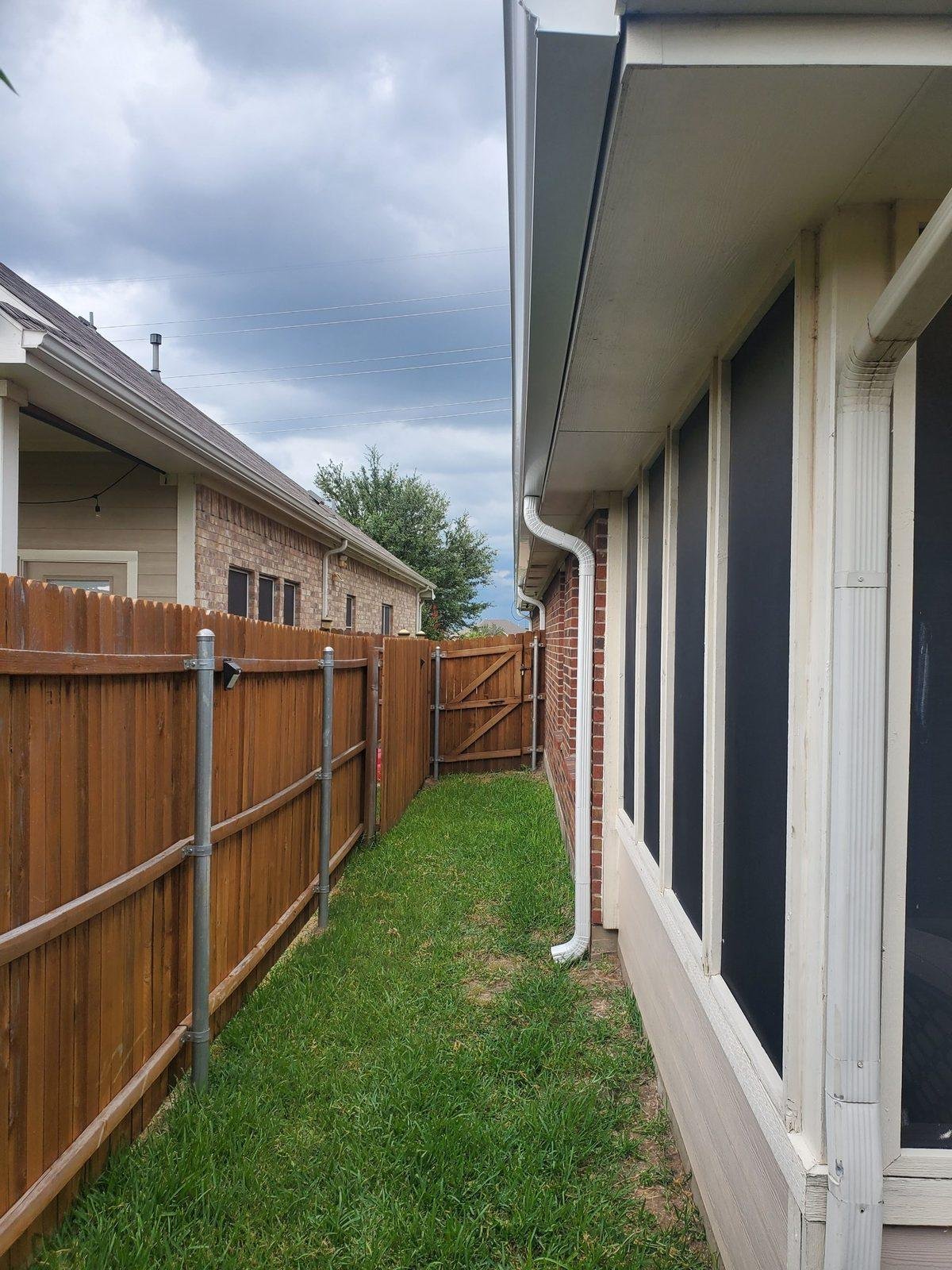
Where the Water Goes Matters More Than the Gutter
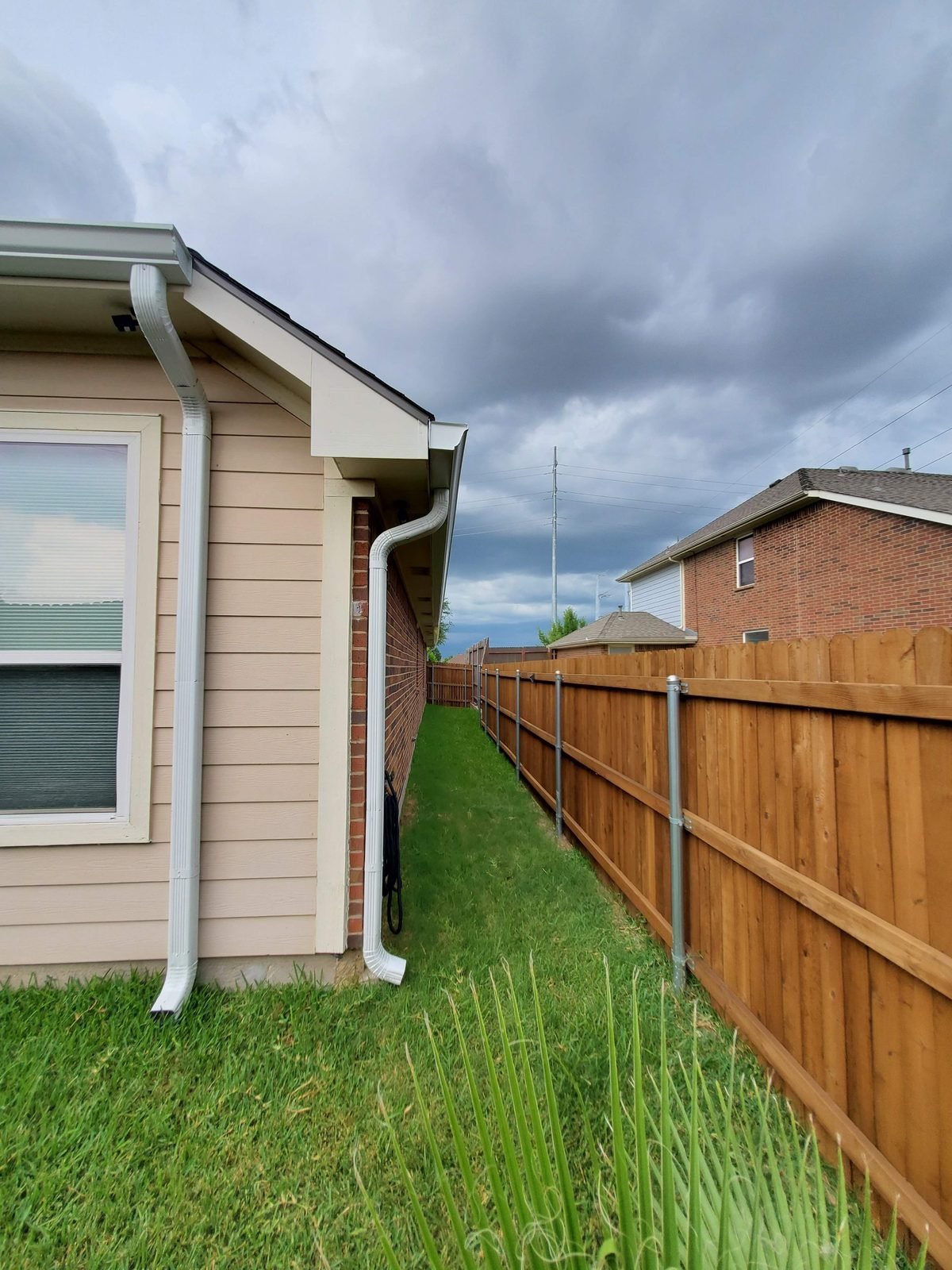
Gutters that discharge at the base of the wall have simply moved the problem four inches. Texas drainage practice is to get roof water at least 5 feet from the foundation, and 7 to 10 feet in expansive clay. Some lots need buried drain lines carrying it farther than that.
This is where most systems fail, and it is cheap to fix:
- Downspout extensions — the simplest version, above ground, moved out of the way when you mow
- Buried drain lines to a pop-up emitter in the yard, the tidiest solution and the one HOAs prefer
- Splash blocks alone are not enough in clay. They spread the water; they do not move it away
- Grade should fall away from the house, roughly 6 inches over the first 10 feet. An extension discharging onto soil that slopes back toward the slab accomplishes nothing
Signs your discharge is too close: erosion channels under the downspouts, standing water beside the slab after a storm, or doors that start sticking seasonally.
Gutters in the Dallas–Fort Worth Metro
DFW is where the argument in this guide matters most, for two reasons that have nothing to do with how much rain falls here and everything to do with how it falls and what it lands on.
It Is Not the Total Rainfall, It Is the Delivery
DFW averages about 37 inches of rain a year — unremarkable, and less than Houston or most of the eastern United States. Homeowners use that number to talk themselves out of gutters.
The number that matters is how it arrives. May is the wettest month at nearly 4.8 inches on average, with October close behind at about 4.4, and those totals are delivered in a handful of violent afternoons rather than spread across the month. DFW Airport’s record daily rainfall is 8.11 inches in a single day in September 2018. In 2022 parts of Dallas took roughly three months of normal rain in about six hours.
A 5-inch gutter system sized for average rainfall is irrelevant on those days, and those are the only days that damage anything. This is the case for going to 6-inch gutters with 3×4 downspouts in this market rather than accepting the builder default.
DFW Soil Is Why It Reaches Your Foundation
More than half of the soil across the Metroplex is expansive clay — the Blackland Prairie, deep and dark and highly reactive, described by the USDA as having very high shrink-swell potential and low strength. It swells when saturated and shrinks when dry, and it can exert enormous pressure on a slab as it does.
It is not uniform across the metro, which is worth knowing before you assume your neighborhood behaves like the next one:
- Blackland Prairie clay covers most of Dallas County and much of Collin, Ellis and eastern Tarrant. This is the highest-risk soil and where drainage discipline matters most
- The Woodbine belt runs from northeast Dallas County down through Grand Prairie and Arlington, and it is genuinely variable — anything from sandy and free-draining to some of the least stable soil in the area, sometimes within the same subdivision
- Trinity River and creek floodplain soils carry expansive clays that can change volume dramatically as moisture cycles
- Western and northwestern Tarrant County tends toward sandier, better-draining ground, though chalk and limestone bring their own issues
The mechanism is the one described earlier in this guide: a roof concentrates runoff into a narrow band of soil at the slab edge, that band swells, and three weeks of Texas summer then bakes it dry. On Blackland clay that cycle is exactly what drives the foundation repair industry in this region, where DFW jobs commonly run $3,300 to $15,000. A $2,500 gutter system with downspouts discharging 7 to 10 feet out is cheap against that.
Permits, HOAs and Where You Are Allowed to Send the Water
Good news on permits: gutters are almost never permitted work anywhere in the Metroplex. Adding, replacing or repairing a gutter system on an existing home is maintenance, not construction.
The HOA is the real constraint in the newer suburbs. Covenants in the master-planned communities across Collin and Denton counties routinely specify downspout color, where downspouts may be placed on street-facing elevations, and whether extensions are allowed to sit above ground. If yours is strict, price a buried drain line to a pop-up emitter from the start — it is what most HOAs prefer and retrofitting it later costs more than doing it once.
And there is a legal limit on where you can send the water. Texas Water Code Section 11.086 says no person may divert or impound the natural flow of surface water in a way that damages another’s property by overflow. Texas otherwise follows a modified common-enemy rule — you may protect your own land from runoff even if that pushes water toward a neighbor — but not unreasonably, and not in a way that causes greater harm than would have happened naturally. Remedies include damages and an injunction to undo the work.
In practice this matters on tight suburban lots. Burying a drain line that dumps roof water at the property line, or regrading so runoff sheets into the yard next door, is how a drainage improvement becomes a lawsuit. Aim discharge toward the street, an alley, or a swale that already carries water — not at the fence.
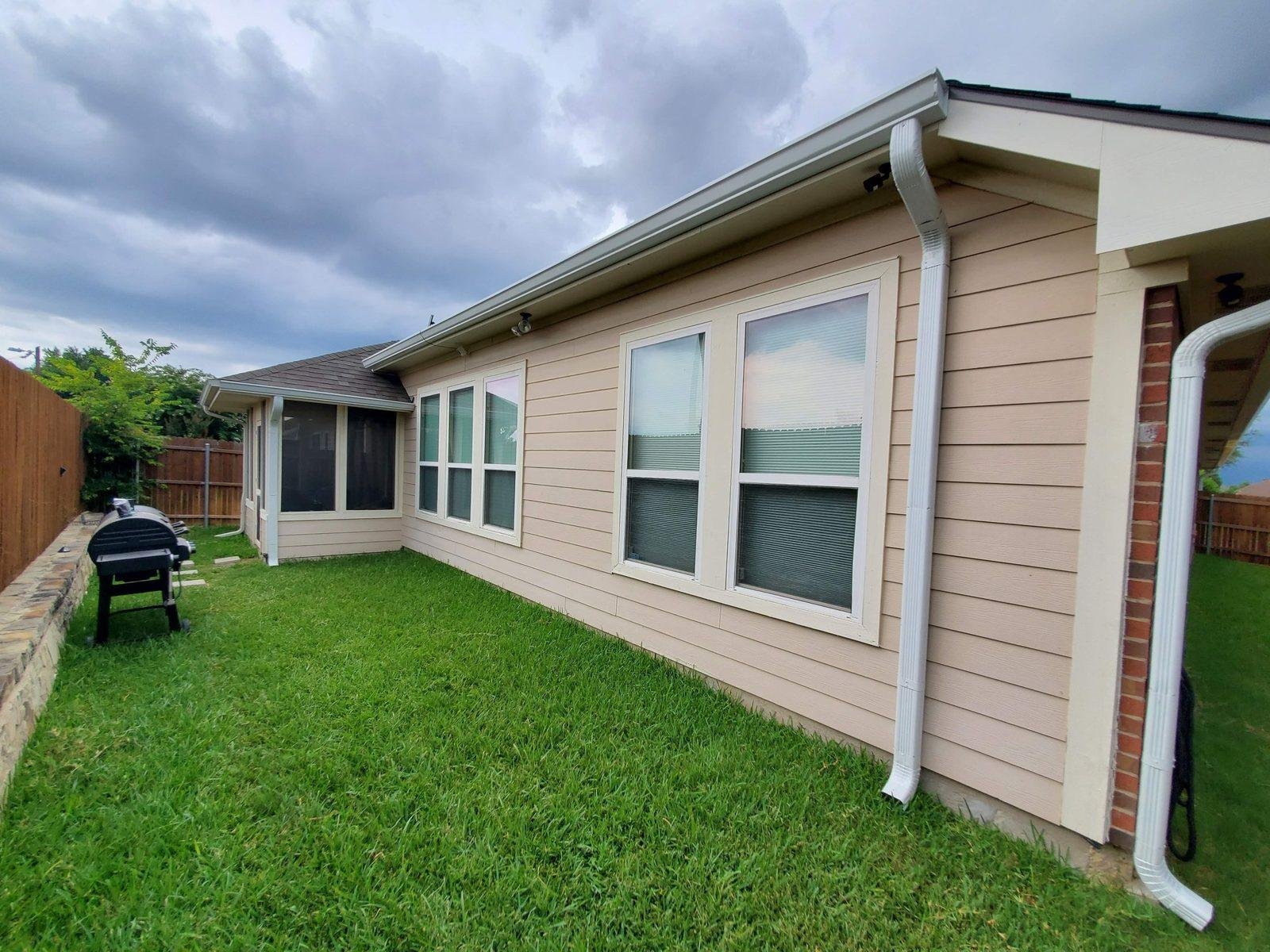
What to Expect from DFW Gutter Contractors
The Metroplex has a large, competitive gutter market, and it is heavily overlapped with the roofing and storm-restoration trade. Two practical consequences:
- After a hailstorm, DFW fills with door-knockers. Some are legitimate local roofers. Many are out-of-state crews following storms. Ask how long they have been at a Metroplex address, and remember that in Texas a contractor offering to waive or absorb your insurance deductible is committing a crime
- Bundle the roof and gutters if hail hit both, since a gutter claim alone almost never clears a percentage wind-and-hail deductible — on a $400,000 dwelling limit at 2 percent, that is $8,000 before the policy pays anything
- Get the fascia inspected before the new gutters go up. Overflowing undersized gutters are the single most common reason DFW fascia rots, and hanging new gutters on soft wood means doing the job twice
Gutter Guards: Worth It or Not?
At $15 to $45 per linear foot installed, guards on a 180-foot house cost $2,700 to $8,100 — frequently more than the gutters themselves. Whether that makes sense depends almost entirely on your trees.
Probably worth it if you have mature oaks, pecans or pines directly over the roof, if the house is two stories and cleaning means hiring someone twice a year, or if you physically cannot get on a ladder safely.
Probably not worth it on a typical newer Texas subdivision lot with young or distant trees. Two cleanings a year at $100 to $250 each will take a long time to add up to $5,000, and no guard eliminates maintenance — fine debris, shingle grit and pollen still get through and still need clearing.
If you do buy them, be skeptical of high-pressure in-home sales pitches, lifetime claims that depend on the original owner staying in the house, and any guard installed by lifting your shingles, which can affect the roof warranty.
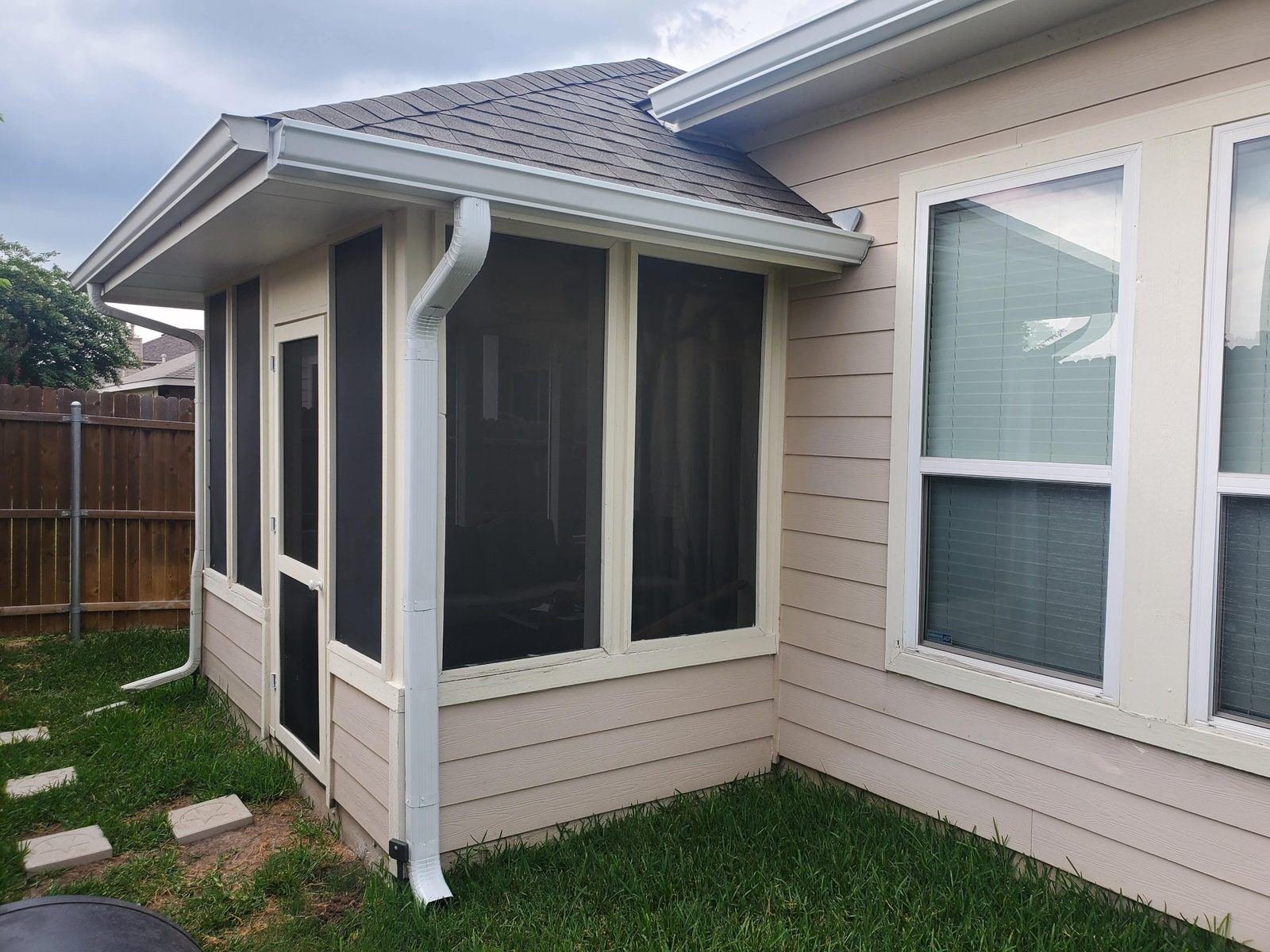
Repair or Replace?
Worth repairing:
- A section pulling away from the fascia — usually failed hangers or rotted fascia board behind them, not bad gutter
- A leaking seam or end cap on a sectional system, resealed for a fraction of replacement
- One damaged run after a limb fell
- Clogs and overflow, which are a cleaning, not a purchase — $100–$250 for a typical house
Worth replacing:
- The system is undersized and overflows even when clean
- Sectional gutters leaking at multiple joints, since every seam is a future leak
- Widespread hail denting that has deformed the channel or the pitch
- Sagging across several runs, which means the hangers and often the fascia have failed together
- Vinyl gutters that have gone brittle and cracked in the sun
If the fascia behind the gutter is rotted, fix that first. Hanging new gutters on soft wood guarantees you do the job twice. That work overlaps with exterior trim and siding repair.
Hail, Wind and Insurance
Gutters are usually part of a Texas storm claim, but rarely on their own. They sit alongside the roof in the settlement, and the same wind and hail deductible applies — in Texas typically a percentage of your dwelling coverage limit rather than of the loss. On a $400,000 dwelling limit at 2 percent, that is $8,000 before the policy pays anything, which no gutter claim reaches by itself.
The practical implication: if a hailstorm dented your gutters, it almost certainly damaged the roof too. Have both inspected at the same time and claim them together, or not at all. Our roof replacement cost guide covers how Texas wind and hail deductibles work in detail, including the rule that a contractor offering to waive your deductible is committing a crime in this state.
What the Quote Usually Leaves Out
- Removal and disposal of the old system: $50–$200
- Fascia repair behind the gutters, which is only discovered once the old run comes down
- Extra downspouts beyond the minimum the bid assumed
- Downspout extensions or buried drain lines — frequently quoted separately, and the part that actually protects the foundation
- Second-story access on complex or steep roofs
- Splash blocks, pop-up emitters and any landscaping repair where lines get buried
- Color matching to existing trim, which can limit you to certain stock
Comparing gutter bids? Scope first, price second
A low per-foot number that skips gutter size, hanger spacing, downspout count, discharge distance, and fascia repair is not a deal — it is a foundation problem waiting to happen. Make every bidder price the same scope (5- vs 6-inch, outlets, splash blocks / extensions, haul-off).
Questions to Ask a Gutter Contractor
- Are you quoting 5-inch or 6-inch, and why that size for this roof?
- How many downspouts, and what size — 2×3 or 3×4?
- Is it seamless, formed on site?
- What gauge is the aluminum? (.027 is common builder grade; .032 is noticeably stronger)
- What hanger system, and at what spacing?
- Are downspout extensions or buried lines included, and how far from the foundation does the water end up?
- Will you inspect and price the fascia before you start?
- What is the labor warranty, in writing, and separate from the material warranty?
Frequently Asked Questions
How often should gutters be cleaned in Texas?
Twice a year for most homes — late spring after the oaks drop, and late fall. Homes under heavy pecan or pine cover may need three. Expect $100 to $250 per cleaning for a single-story house.
Do I really need gutters in Texas?
Many Texas builders skip them, which is where the idea that they are optional comes from. On expansive clay, they are the cheapest protection available for the most expensive thing on your property. If you only gutter part of the house, prioritize the runs above the longest uninterrupted stretches of foundation and anywhere runoff currently digs a trench.
How long do aluminum gutters last?
Twenty years or more with routine cleaning, often longer. In practice the fascia they hang on and the hail that dents them usually decide the lifespan before the aluminum wears out.
Can I install gutters myself?
Sectional gutters from a home center are a realistic DIY job on a single story if you are comfortable on a ladder and can set pitch accurately. Seamless gutters are not — they are formed on site by a machine you do not own. Cleaning and adding downspout extensions are both very much DIY, and the extensions are where most of the benefit is anyway.
What slope should gutters have?
Roughly a quarter inch of fall per 10 feet toward the downspout. Too little and water stands and breeds mosquitoes; too much and it looks crooked from the street and overshoots at the outlet.
Get Quotes Before You Commit
Ask each bidder to price 6-inch gutters with 3×4 downspouts so you are comparing the same system rather than three different ones.
Compare gutter quotes on Angi →
Ultimate Home Fix may earn a commission if you request quotes through this link. It costs you nothing and does not change what a contractor charges.
Where these numbers come from, and what they are not
Written by Jimmy Hall, a Texas homeowner — not a contractor, plumber, electrician or adjuster. Why that matters.
Every price on this page is a range, not a quote. What you actually pay moves with your metro, the size and access of the job, the season, and how much existing work has to come out before the new work goes in. Treat these as the band a fair bid should land in, and use the calculator above to put your own numbers against it.
Anything here about Texas law, building code or insurance is cited to a primary source — the statute itself, the Texas Administrative Code rule, the agency that adopted it, or the city’s own permit documents. Not to another blog. Where sources genuinely conflict and no authority settles the question, this site says so plainly rather than picking one and sounding certain.
Reviewed September 2026. Texas changes on a fixed schedule — building codes and new laws take effect on September 1, and tax credits change with the calendar year — so these pages are re-checked at least twice a year, and sooner when something we track moves. How we research prices and rules.
How this site makes money. Some outbound links are affiliate links and we may earn a commission if you use one. That has no bearing on the figures above, and nothing here is a paid placement. We do not sell repairs, we do not sell your details to contractors, and there is no lead form on this page.
Think something here is wrong? Tell us — especially if you do this work for a living. A correction that comes with a source gets made.
Related Guides
Roof drainage touches almost everything at ground level. If you are dealing with water in the wrong place, these are usually part of the same problem:
- Driveway and concrete repair cost — a downspout discharging at the edge of a slab washes out the base underneath it. If a section of your drive or walk has settled, look at where the water lands first
- Garage door repair cost — the garage is usually the low point roof water runs toward, and a door that no longer seals at the bottom is often a drainage problem before it is a door problem
- Fence installation cost — concentrated runoff along a fence line rots posts at grade faster than anything else on the property
- Siding and trim repair cost — overflowing gutters are the number one reason Texas fascia rots. Fix the drainage in the same project or you will do the trim twice
The Bottom Line
Budget $6 to $13 per linear foot for seamless aluminum, or roughly $2,200 to $4,500 for a typical 1,800-to-2,000-square-foot Texas home. Then spend the small upgrades where they count: go to 6-inch gutters with 3×4 downspouts, add downspouts rather than accepting the minimum, and put the water 7 to 10 feet from the slab.
Those three decisions add a few hundred dollars to the job and are the entire difference between a gutter system that decorates your roofline and one that protects your foundation.
Next steps that protect your wallet
- Confirm 6-inch gutters and enough downspouts for Texas downpours — undersized 5-inch runs dump water next to the slab.
- Get at least 3 written quotes that state size, hanger type/spacing, outlet count, discharge distance, and any fascia repair.
- Still torn on repair vs replace? Use the repair-or-replace tool, then line bids up with how to read a contractor bid and Texas bid red flags.
Owned tools and guides here aren’t a contractor lead marketplace — when you want comparable written quotes, use the Angi compare path on this page (affiliate). More orientation: Start Here · Tools.
Recommended Product
Most gutter repairs start with debris buildup — a 5″ Aluminum Gutter Guard, 50ft on Amazon → is a DIY-friendly way to cut way down on clogs, overflow, and the repeat cleanings that eventually wear gutters out.
As an Amazon Associate, we earn from qualifying purchases.