
Fixing a house in Houston is not the same job as fixing one in Dallas–Fort Worth, Austin, El Paso or Ohio. Five things change the answer here: clay that shrinks and swells under the slab, water with nowhere to go, hurricanes and derechos that take the power out for days, heat and humidity that turn a small leak into mold, and a city with no zoning but plenty of permit rules. This guide covers what is specific to the Houston area and points to our deeper guides where the answer is the same statewide.
Everything below is checked against the source that actually decides it: the National Weather Service, FEMA, the Texas Department of Insurance, the Houston Permitting Center, and each suburb’s own website. Where a city does not say, we say so instead of guessing.
The ground: gumbo clay and a sinking coast
Most of the Houston area sits on clay soils of the Beaumont Formation, mapped by the USDA as series such as Lake Charles and Beaumont. Both are Vertisols: very deep, very slowly permeable clays with “a high content of expanding clay” that “shrink as they dry and swell as they become moist,” in the USDA’s words. In most years the Lake Charles soils crack open for 60 to 90 days in total. A University of Houston geotechnical paper puts the consequence plainly: changes in subsoil moisture “result in settlement or heave of foundations,” and the 2011 drought increased the potential for that movement.
The coast is also sinking. The Harris-Galveston Subsidence District traces subsidence back to 1918 near Baytown, where some areas sank more than 9 feet over four decades; the Brownwood subdivision sank nearly 10 feet and was abandoned. Subsidence is irreversible and adds to flood risk, and it has shifted farther inland as groundwater pumping moved. The District now caps how much of an area’s water can come from groundwater (as little as 10% in its Area 1).
What this means for you: most Houston homes sit on slabs that move a little with the seasons. Small cosmetic cracks are normal; doors that stick, cracks that keep widening and gaps at window frames are worth an engineer’s look. Our foundation repair cost guide covers prices, which pier type suits clay, and when to repair versus replace. One insurance point: the Texas Department of Insurance lists damage to foundations or slabs among the common endorsements (add-ons) insurers offer, so check whether your policy has one before you need it.
Watering and the foundation
As of October 9, 2026, the City of Houston lists no active drought stage: Stage One was rescinded on May 29, 2024. When Stage Two was in force in 2023, sprinklers were limited to twice a week between 7 p.m. and 5 a.m., while handheld hoses and drip irrigation were allowed at any time. Check the city’s current-restrictions page before you set a schedule.
We looked for official guidance on how much to water around a foundation in Houston and did not find any from the city or Texas A&M extension, so we won’t invent a soaker-hose schedule. What the soil science does support: steady moisture is better than wet-dry swings, and drainage comes first. Water that pools against the slab after every storm is a bigger problem than a dry August. Our drainage case study shows what fixing that looks like.
Flooding: plan for it even outside the floodplain
The Harris County Flood Control District says a major flood happens somewhere in the county about every two years. Hurricane Harvey set the benchmark in 2017: 36 to 48 inches of rain across the Houston metro (National Hurricane Center), about 1 trillion gallons on Harris County in four days, and roughly 136,000 structures flooded in the county by the District’s preliminary count. Harvey caused at least 68 direct deaths in Texas, 36 of them in Harris County.
| Date | Storm | What happened (official figures) |
|---|---|---|
| Sep 13, 2008 | Hurricane Ike | Category 2 landfall at Galveston; 15–20 ft surge on Bolivar Peninsula; a 92 mph gust at Hobby; 2.6 million customers without power in Texas and Louisiana |
| Aug 25–31, 2017 | Hurricane Harvey | 36–48 in of rain across the metro; ~136,000 Harris County structures flooded (preliminary); record pools at Addicks and Barker reservoirs |
| Sep 17–19, 2019 | Tropical Storm Imelda | 31.72 in at a county flood-warning gauge on the East Fork San Jacinto; up to 3,100 homes flooded in Harris, Liberty and Montgomery counties |
| Feb 2021 | Winter Storm Uri | 12°F at Bush Intercontinental on Feb 16; more than 4.5 million Texans lost power; 43 storm deaths in Harris County |
| May 16, 2024 | Derecho | A swath of 100+ mph winds through the Houston metro and a couple of tornadoes; about 1,600 utility poles replaced |
| Jul 8, 2024 | Hurricane Beryl | Category 1 landfall near Matagorda; 83–84 mph gusts at Bush and Hobby; 2.7 million people without power in southeast Texas |
Sources: National Hurricane Center storm reports, NWS Houston/Galveston, Harris County Flood Control District, CenterPoint Energy, FERC and the Texas Department of State Health Services. Links are in the Sources list at the end.
Flood insurance: the 30-day rule
- Your home policy almost certainly excludes flood. The Texas Department of Insurance: “Most home policies don’t cover damage caused by floods.” TDI also lists sewer and drain backup among the common add-on endorsements.
- An NFIP policy takes 30 days to start, except when you buy it with a new or refinanced mortgage (no wait) or within a year of your property being mapped into a high-risk zone (one day). Buy it in spring, not when a storm is in the Gulf.
- NFIP limits: $250,000 for the building and $100,000 for contents.
- Outside the floodplain still floods. FEMA says about one-third of NFIP claims from 2013 to 2023 came from outside high-risk areas. The average claim payment from 2019 to 2023 was $52,000.
- Premiums: under FEMA’s Risk Rating 2.0, most annual increases are capped at 18%.
- If a flood badly damages the house, NFIP’s Increased Cost of Compliance coverage can pay up to $30,000 toward elevating, moving or demolishing it. It applies to insured homes in high-risk zones that the local floodplain office declares substantially damaged (repairs of 50% or more of pre-damage value).
Floodplain permits and the 50% rule
Since September 1, 2018, the City of Houston’s Chapter 19 floodplain rules require new homes in both the 100-year and the 500-year floodplain to be built to the 500-year flood level plus 2 feet. In the 100-year floodplain, the same elevation applies to existing homes that are substantially improved or substantially damaged, meaning work or damage costing at least 50% of the structure’s market value. In the 500-year floodplain, it applies to additions larger than one-third of the home’s footprint. The city’s Floodplain Management Office (832-394-8854) issues permits for any construction in the 500-year floodplain, so a big remodel or a post-flood rebuild there starts with that office, not with the contractor.
Outside city limits, Harris County’s Engineering Department requires a floodplain development permit for all work in the floodplain, and new structures in or next to the floodplain need two elevation certificates: one before the slab is poured and one after construction.
To check your own risk, the Harris County Flood Warning System (harriscountyfws.org) shows live rainfall and bayou levels and offers text and email alerts. The county’s MAAPnext project has published draft flood maps built on newer rainfall data; the county calls this the most comprehensive update since 2007 and says the drafts are for awareness only, not insurance or regulation. The county’s own advice: every structure in Harris County should have flood insurance.
Ditches, culverts and the drainage fee
Houston Public Works maintains about 3,900 miles of storm sewer and about 2,500 miles of roadside ditches. Two jobs fall on the homeowner: keeping the ditch next to your lot clear, and replacing a damaged or undersized driveway culvert, which goes through city permitting. If a ditch still holds water 48 hours after rain, report it to 311. Your drainage charge is based on your property’s impervious area, so a new patio or wider driveway raises it. For water around the house itself, start with the gutters and grading.
Selling or renting a home that has flooded
Texas sellers must disclose whether the home is in a 100-year or 500-year floodplain, a floodway or a flood pool, whether it has flooded, and whether there were flood insurance claims or FEMA or SBA flood aid (Property Code §5.008, updated September 1, 2019). Since January 1, 2022, landlords must also give tenants a separate written flood notice at or before lease signing (§92.0135). Keep your repair and claim records. You will need them.
Hurricanes, derechos and windstorm insurance
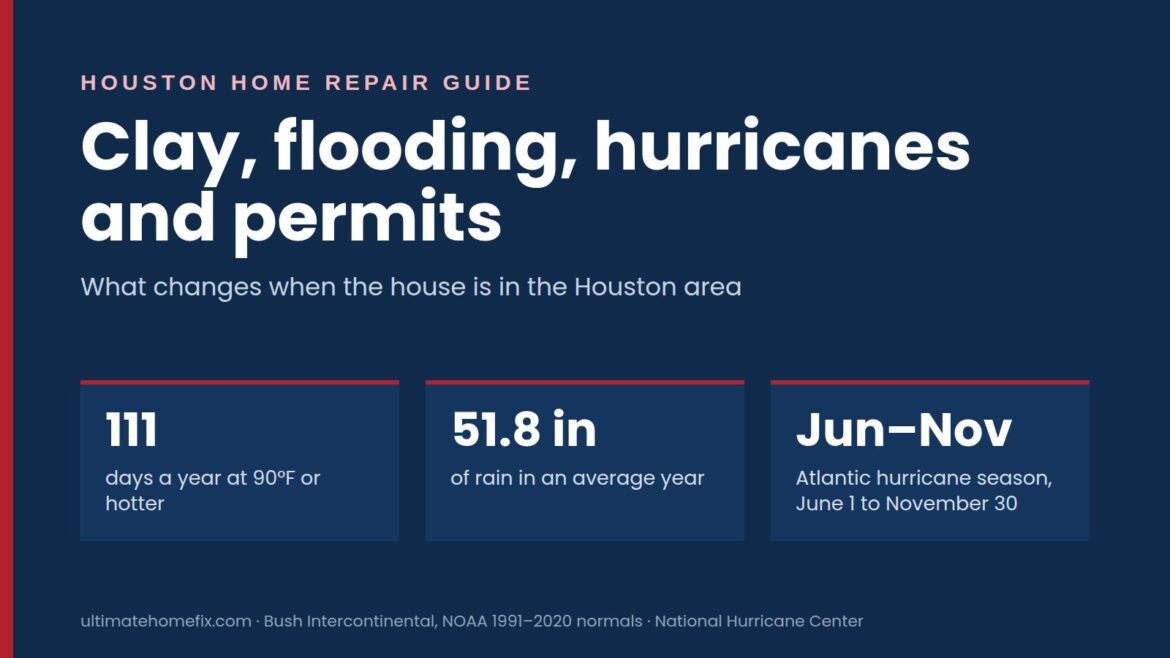
Atlantic hurricane season runs June 1 to November 30. The last two big wind events showed what a Houston outage looks like: when Beryl came ashore on July 8, 2024, almost 3 million people lost power, 2.7 million of them in southeast Texas, and CenterPoint reported more than 98% of affected customers restored on July 17, nine days after landfall. Of Texas’s 34 indirect deaths from Beryl, 14 were heat-related and blamed on the outages. Two months earlier, the May 16 derecho pushed a swath of 100+ mph winds through the metro.
Are you in the windstorm (TWIA) area?
The Texas Windstorm Insurance Association covers wind and hail in the Texas Department of Insurance’s “catastrophe area”: 14 coastal counties, including Galveston, Brazoria and Chambers. Harris County is only partly in. A Harris County property qualifies only if it is east of State Highway 146 and inside the city limits of Seabrook, La Porte, Shoreacres, Pasadena or Morgan’s Point. So communities in those counties, including most of League City (Galveston County) and most of Pearland (Brazoria County), are in the area, while most of Houston is not.
Inside the catastrophe area, TDI requires an inspection for roof replacements, major repairs and other alterations. Small roof repairs under 100 square feet that don’t touch the decking, plus painting, fences, gutters and glass, are exempt. An inspection during the work earns a WPI-8 certificate; work that wasn’t inspected along the way needs an engineer’s WPI-8-E afterward. Most homes need a certificate to buy a TWIA policy, so ask your roofer before the old roof comes off who is scheduling the TDI inspection.
If you do file with TWIA, you have one year from the date of damage to report the claim; the insurance commissioner can extend that by 180 days for good cause.
Deductibles and storm-chasing roofers
TDI states it flatly: it is illegal in Texas for a contractor to offer to waive, rebate or absorb your deductible. Contracts of $1,000 or more that will be paid by insurance must include a deductible notice, and a roofer doing the work cannot also act as your public adjuster. Under Texas claim rules, your insurer has 15 business days to acknowledge a claim and, once it has what it needs, 15 business days to accept or deny it (extendable by 45 days); after a weather catastrophe TDI can add 15 days. Before you file, run the numbers with our deductible calculator and decide whether to claim or pay cash. Then check every bid against the bid red-flags checklist. The 2026 Texas insurance changes affect Houston policies too.
Freezes: rare, short and still expensive
Bush Intercontinental averages about 10 days a year at or below freezing (1991–2020 normals), so it is easy to forget about pipes in attics and exterior walls until a hard freeze arrives. Winter Storm Uri showed the cost: 12°F at Bush on February 16, 2021, more than 4.5 million Texans without power, and 246 storm-related deaths statewide, including 43 in Harris County; 19 of the deaths statewide were carbon monoxide poisonings. Smaller freezes followed: 15°F on December 23, 2022, and 18°F on January 16, 2024, a record low for the date.
Before the next one, winterize outdoor pipes and faucets, read how to protect your pipes before the next cold snap, and work through the Texas fall and winter checklist. If your water heater lives in the attic, our attic water heater guide covers the drain pan and permit rules. Never run a generator, grill or car in a garage or inside the house.
Heat and humidity: your AC is also your mold control
Houston’s 1991–2020 normals at Bush Intercontinental: 111 days a year at 90°F or hotter, an average July high of 94.5°F, and 51.84 inches of rain a year. That combination makes the air conditioner a moisture-control system as much as a comfort one.
- Humidity: the EPA recommends keeping indoor humidity below 60%, ideally 30–50%.
- Size matters: ENERGY STAR notes that an oversized AC short-cycles, and short run times “do not allow the system to effectively remove humidity.” Bigger is not better in Houston.
- Efficiency floor: a new split-system central AC under 45,000 Btu/h installed in Texas must be at least 14.3 SEER2 (federal rule since January 1, 2023). See what SEER2 and the refrigerant change mean for you.
- Leaks: the EPA says to dry water-damaged areas within 24 to 48 hours to prevent mold. A slow condensate line is one of the most common slow leaks here.
For the big decisions, see AC replacement costs and repair or replace. If mold has already started, compare water damage and mold remediation costs and check what Texas law lets you remove yourself.
Termites: Formosan territory
Formosan subterranean termites were first found in Texas in 1956 at the Houston Ship Channel in Pasadena. Texas A&M AgriLife says they swarm at night in late May and early June and are drawn to lights, and a single colony can exceed a million insects. If you see swarmers around porch lights in late spring, get an inspection.
Pest control companies in Texas must be licensed by the Texas Department of Agriculture’s Structural Pest Control Service (866-918-4481). Termite treatment bids must come with written disclosures: a diagram, the termiticide label and the warranty terms. A wood-destroying-insect inspection for a home sale is not a warranty.
Utilities, outages and backup power
- Electricity: CenterPoint Energy owns the poles and wires in most of the metro; you buy power from a retail provider you choose on the state’s Power to Choose site, unless a co-op or city utility serves you. Report outages to CenterPoint (800-332-7143), not to your retail provider.
- Gas leak: leave the house on foot, then call CenterPoint (713-659-2111 in Greater Houston) and 911.
- Water: Houston Water serves about 2.2 million customers a day; report leaks to 311. Outside the city, many neighborhoods get water, sewer and drainage from a municipal utility district (MUD), which can levy its own tax. The seller’s notice to purchaser shows the MUD tax rate and bonds.
- Rebates: CenterPoint funds efficiency programs, such as AC tune-ups, HVAC incentives applied to a participating contractor’s invoice, and a smart-thermostat rebate, delivered through contractors rather than directly. Offers change, so check our savings and rebates guide and CenterPoint’s current list.
Standby generators after Beryl
Since September 1, 2025, a state law (SB 1252) limits how cities regulate home backup power: cities may not regulate the installation or inspection of a residential backup system of 50 kW or less (or battery storage of 100 kWh or less). Houston now inspects only the service connections. You still need an electrical permit for the connection (a temporary cut-in or reconnect permit) and a gas permit, and in Houston only a licensed electrical contractor registered with the city can pull the electrical permit. HOA approval may still apply. Ask the installer how the unit meets the manufacturer’s clearances from windows, doors and walls. Houston’s earlier generator guidance cited a 5-foot fire-code clearance from openings and combustible walls, including brick veneer.
Building codes and permits around Houston
Houston famously has no citywide zoning, but that doesn’t mean anything goes. Deed restrictions do much of zoning’s work, and the City’s Legal Department can enforce certain restrictions, including use, setbacks, lot size and some fences (hotline 832-393-6333). Read your neighborhood’s restrictions before a fence, addition or carport.
| City | Building / residential code | Electrical code (as posted) | Who issues permits |
|---|---|---|---|
| Houston | 2021 Houston Construction Code (2021 IBC/IRC; Uniform Plumbing and Mechanical codes), effective Jan 1, 2024 | 2026 NEC for applications from Sep 1, 2026 | Houston Permitting Center |
| Sugar Land | 2024 I-codes | 2023 NEC | City of Sugar Land |
| Pearland | 2021 I-codes | 2023 NEC | City of Pearland |
| Katy | 2021 I-codes | 2023 NEC | City of Katy |
| League City | 2021 I-codes | 2023 NEC | City of League City |
| Pasadena | “2024 codes” effective Feb 2, 2026 | Not listed | City of Pasadena |
| The Woodlands | No county building permit for a roof; Township covenants apply | — | Montgomery County and The Woodlands Township |
| Unincorporated Harris County | Development and floodplain permits | — | Harris County Engineering Department |
Texas adopted the 2026 National Electrical Code statewide on September 1, 2026. Several suburbs still post the 2023 edition, so ask your permit office which one your job will be reviewed under.
Does this job need a permit?
| City | Roof replacement | Fence | Water heater | HVAC replacement | Foundation repair |
|---|---|---|---|---|---|
| Houston | Yes (repairs of 100 sq ft or less exempt) | Over 8 ft, or masonry/concrete at any height | Yes (plumbing permit) | Yes | Listed: building permit plus engineered pier drawings (confirm outside flood zones) |
| League City | Yes, over 100 sq ft | Over 7 ft | Yes | Yes | Yes |
| Katy | Yes | Check | Yes | Yes | Check |
| Pasadena | Yes, over 25% of a roof | New fence yes; like-for-like no | Check | Check | Check |
| Pearland | Check | Yes, all fences | Check | Check | Check |
| Sugar Land | Check | New fence yes; like-for-like no | Check | Check | Check |
| The Woodlands | No county permit; Township approval required | Township approval to replace more than 8 linear ft | Check | Like-for-like pre-approved by Township | Check |
| Unincorporated Harris County | Check | No permit outside a flood hazard area | Check | Check | Floodplain permit if in a floodplain |
“Check” means the city’s current website doesn’t say; call the permit office. In Houston, most electrical, plumbing and mechanical work needs a permit even when the building work doesn’t; suburbs vary.
Can you pull your own permit in Houston?
- Building: yes. The city sells building permits to the owner, an agent or a contractor.
- Plumbing: yes, with a Homeowner’s Plumbing Permit, if you own and live in the home, it is your registered homestead, and you do the work yourself. State law (Occupations Code §1301.051) exempts homeowners working on their own homestead from plumber licensing. One catch: the city’s water heater permit page says that permit must be pulled by a registered master plumber, so ask 311 or the Permitting Center before planning a DIY water heater swap.
- Mechanical (HVAC): sometimes. The city says a homeowner may obtain this permit “in some instances.”
- Electrical: no. Houston issues electrical permits only to licensed electrical contractors registered with the city, even though state law exempts owner-occupants from licensing, because cities may override that exemption. See the Texas home repairs you are not allowed to do yourself.
- Driveway: yes when no curb cut is needed; a curb cut requires a bonded contractor.
Licenses and checking a contractor
Texas licenses electricians and air-conditioning contractors (TDLR) and plumbers (State Board of Plumbing Examiners); both have public license searches. Texas still does not license roofers or general contractors. A 2025 bill to license reroofing contractors (HB 3344) died without a floor vote, and TDLR’s list of licensing programs has no roofing or general contractor program. In Houston, plumbers, A/C contractors and electricians must also register their licenses with the city to pull permits. To see what has been permitted at an address, use the Houston Permitting Center’s Sold Permits Search (the last three years) or call 311. Then read how to read a contractor bid before you sign.
What repairs cost in Houston
Our cost guides cover Texas as a whole. A few Houston-specific items can add to a job’s cost: TDI windstorm inspections in the catastrophe area, engineered drawings for foundation permits, and floodplain permits and elevation in flood zones. Start here:
- Foundation repair costs in Texas
- Roof replacement costs
- AC replacement costs
- Water heater replacement costs
- Water damage and mold remediation costs
- Gutter installation and repair costs
- Repiping costs
- Window replacement costs
- Attic insulation costs
Where to start
- Look up your flood risk and, if you don’t have flood insurance, buy it now. It takes 30 days to start.
- Run the deductible calculator so you know what a roof claim would actually pay.
- If you’re in the windstorm area, make the TDI inspection a line item in any roofing contract.
- Check bids against the red-flags checklist, especially after a storm.
- Protect exposed pipes before the first freeze warning.
- Get the AC serviced before summer, and keep indoor humidity under 60%.
Where these numbers come from, and what they are not
The facts on this page were checked on October 9, 2026 against the agency and city sources listed below. Codes, permit rules, insurance rules and utility programs change, and suburbs update their websites on their own schedules, so confirm with your permit office or insurer before you start a job. This page is general information, not legal, engineering or insurance advice. How we research prices and rules.
Some of the guides linked here contain affiliate links; see our disclosure. There is no lead form on this page and no one pays to be mentioned on it. Spot something out of date? Tell us.
Written by Jimmy Hall, a Texas homeowner, not a contractor, plumber, electrician or adjuster. Why that matters.
Sources
- USDA NRCS — Lake Charles official soil series description
- USDA NRCS — Beaumont official soil series description
- USDA NRCS — Vertisols
- University of Houston CIGMAT — Gulf Coast expansive clays and foundations (2012)
- Harris-Galveston Subsidence District — What is subsidence
- Harris-Galveston Subsidence District — Regulatory plan
- Houston Public Works — Current watering restrictions
- Houston Public Works — Stage Two drought FAQ (2023)
- Texas Department of Insurance — Home insurance guide
- National Hurricane Center — Hurricane Harvey report
- NWS Houston/Galveston — Hurricane Harvey
- Harris County Flood Control District — Harvey immediate report (Sep 2017)
- Harris County Flood Control District — Harris County’s flooding history
- National Hurricane Center — Tropical Storm Imelda report
- National Hurricane Center — Hurricane Ike report
- NWS Houston/Galveston — Hurricanes of the 2000s (Ike surge)
- National Hurricane Center — Hurricane Beryl report
- CenterPoint Energy — Hurricane Beryl restoration updates
- NWS Houston/Galveston — May 2024 climate summary (derecho)
- CenterPoint Energy — May 2024 derecho response
- NHC — Tropical cyclone climatology (hurricane season)
- FloodSmart (FEMA) — Buying a flood insurance policy
- FEMA — NFIP fast facts (Nov 2024)
- FEMA — Understanding Risk Rating 2.0 (2025)
- FloodSmart (FEMA) — Increased Cost of Compliance
- 44 CFR 59.1 — Substantial damage and substantial improvement
- City of Houston — Chapter 19 floodplain guidelines (2018)
- City of Houston — Housing notice confirming Chapter 19 elevation (May 2026)
- Houston Permitting Center — Floodplain Management Office
- Harris County Engineering — Floodplain management
- Harris County Flood Control District — Flood Warning System
- Harris County — MAAPnext: understand your risk
- Houston Public Works — Stormwater maintenance
- Houston Public Works — Ditch information
- RebuildHouston — Explanation of the drainage utility charge
- Texas Legislature — SB 339 (2019) seller flood disclosure analysis
- Texas Legislature — HB 531 (2021), landlord flood disclosure, §92.0135
- Texas Department of Insurance — Windstorm general questions (catastrophe area)
- Texas Department of Insurance — Harris County windstorm map
- Texas Department of Insurance — Do you need a windstorm inspection?
- TWIA — How long do I have to report a claim?
- Texas Department of Insurance — Roofing and insurance: know the law
- Texas Department of Insurance — Getting your insurance claim paid
- NWS Houston/Galveston — IAH climate normals
- NOAA NCEI — Houston IAH local climatological data, 2023 annual
- NWS Houston/Galveston — February 2021 winter storm
- FERC — Final report on the February 2021 freeze
- Texas DSHS — February 2021 winter storm mortality report
- NWS Houston/Galveston — December 2022 climate summary
- NWS Houston/Galveston — January 2024 climate summary
- EPA — A brief guide to mold, moisture and your home
- ENERGY STAR — Right-sized air conditioners
- 10 CFR 430.32 — Federal central AC efficiency standards
- Texas A&M AgriLife — Formosan subterranean termite
- Texas Department of Agriculture — Termite FAQs
- Public Utility Commission of Texas — Choosing an electric plan
- Public Utility Commission of Texas — Utility outage contacts
- CenterPoint Energy — What to do if you smell natural gas
- CenterPoint Energy — Residential electric efficiency programs
- Houston Public Works — Houston Water
- TCEQ — Texas water districts: a general guide (GI-043)
- Houston Permitting Center — Residential backup power process updates (SB 1252)
- Houston Permitting Center — Generator installation guidance (Form CE-1060)
- City of Houston Legal Department — Deed restriction enforcement
- City of Houston Planning — No-zoning letter (2026)
- Houston Permitting Center — Code amendments (2021 Houston Construction Code)
- Houston Permitting Center — Code Word 2021 (adopted editions)
- Houston Permitting Center — 2026 NEC effective September 1, 2026
- TDLR — Commission adopts 2026 NEC (16 TAC §73.100)
- Houston Permitting Center — Re-roof permit
- Houston Permitting Center — Fence permit
- Houston Permitting Center — Water heater permit
- Houston Permitting Center — Condensing unit (HVAC) permit
- Houston Permitting Center — Foundation repair permit
- Houston Permitting Center — Driveway permit
- Houston Permitting Center — Residential permitting workshop (exempt work, Nov 2024)
- Houston Permitting Center — Residential permit guide (who may buy permits)
- Houston Permitting Center — Homeowner’s plumbing permit
- Houston Permitting Center — Electrical administrative provisions
- TSBPE — Plumbing License Law (Occupations Code §1301.051)
- TDLR — Electrician licensing exemptions
- TDLR — Air conditioning and refrigeration contractors
- Texas Legislature — HB 3344 (2025) bill analysis
- Texas Legislature — HB 3344 (2025) bill history
- TDLR — Licensing programs
- Houston Permitting Center — Sold permits search
- City of Houston — 311 FAQ
- City of Sugar Land — Building codes
- City of Pearland — Adopted building codes
- City of Pearland — Planning FAQ (fences)
- City of Katy — City codes
- City of Katy — Permits and building
- City of League City — Building
- City of League City — When is a permit required?
- City of Pasadena — Permits and licenses
- City of Pasadena — Fee schedule (roof and fence permits)
- Montgomery County — Permitting FAQ
- The Woodlands Township — Residential development standards (2024)
- Harris County Engineering — Permits FAQ
- City of Sugar Land — Residential permit categories (generators)
- City of Sugar Land — Permit FAQs (fences)