
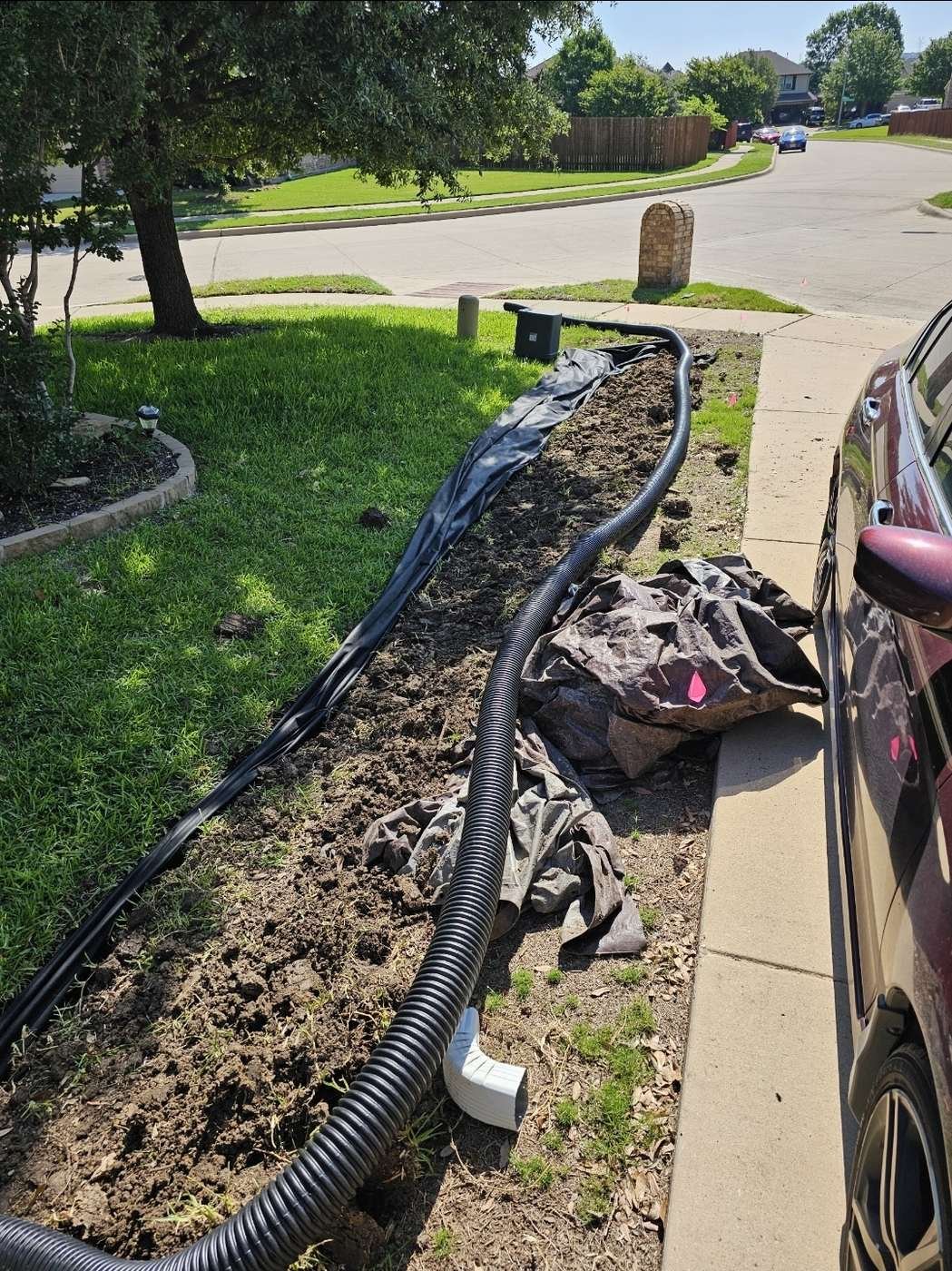
Fixing a house in Dallas–Fort Worth is not the same job as fixing one in Houston, Austin, El Paso or Ohio. Four things make it different here: clay soil that swells and shrinks under every slab, some of the worst hail in the country, a few hard freezes a year that houses aren’t built for, and more than a dozen cities that each run their own permits and building codes. This page pulls the DFW-specific facts together in one place and points to the deeper guides for each job.
Everything below is checked against the source that actually decides it — the city’s own permit pages, the National Weather Service, the Texas Department of Insurance, the utilities themselves. Where sources disagree, it says so.
The ground: why DFW foundations move
Much of the metro, especially Dallas and the eastern suburbs, sits on the Blackland Prairie, where the dominant soil is Houston Black clay — Texas’s official state soil. The Texas Water Development Board describes it as a soil that “shrink[s] and swell[s] markedly with changes in moisture content,” and notes its “very high shrink-swell potential commonly is a limitation affecting building site development.” In a dry spell it cracks open; after rain it swells back. A slab sitting on top of it rides that movement, usually unevenly.
Fort Worth and the western side sit mostly on the Grand Prairie and Cross Timbers instead — limestones, marls and sandier soils. That means less of the deep, high-swell clay, not none. Plenty of Tarrant County homes still have foundation movement; it just tends to be less severe than in parts of Dallas and Collin counties.
What this means for your house:
- Water is the lever. The Texas Department of Licensing and Regulation’s inspector bulletin on expansive soils says drainage, plant choices, sprinkling and long-term maintenance all matter in “minimizing fluctuations in the soil water content,” and that water must “drain away from the house on all sides.” Our DFW drainage case study shows what a fix that works looks like, photographed start to finish.
- Consistent, moderate foundation watering in drought. Dallas-area guidance from Texas A&M AgriLife is a soaker or drip line 6–18 inches out from the slab, run until the soil is moist 6–8 inches deep — not flooding it. Consistency matters more than volume.
- When it’s already moving: start with foundation repair costs in Texas, then which pier type and repair versus replace.
Foundation watering and city watering rules
Most DFW cities limit sprinkler days, but nearly all of them treat hand watering, soaker hoses and drip lines differently — which is exactly what foundation watering uses. As posted by each city or water utility (rules tighten if a drought stage is declared, so check before relying on this):
| City | Sprinkler rule | Foundation watering |
|---|---|---|
| Dallas | Twice a week year-round by address; no sprinklers 10am–6pm, Apr 1–Oct 31 | Hand watering, soaker hoses and drip allowed any day, any time |
| Fort Worth | Twice a week year-round by address (no Monday watering); no sprinklers 10am–6pm | Hand-held hose any time; drip allowed “for the protection of structural foundations” |
| Arlington | No irrigation 10am–6pm; no day-of-week limit unless a drought stage is declared | Hand watering and soaker hoses exempt |
| Plano | Voluntary twice-a-week guideline Apr–Oct; no sprinklers 10am–6pm | Hand-held or soaker hose up to 2 hours any day; drip as needed |
| Irving | Mandatory twice a week by address; no watering 10am–6pm Apr–Oct | Not addressed; free-flowing hoses banned (shutoff nozzle required) |
| Frisco | Seasonal plan: no winter turf watering; once a week spring/fall; twice in summer | Hand-held, soaker and drip allowed |
| Garland | Sprinklers 2 days a week Apr–Oct, 1 day Nov–Mar; none 10am–6pm Apr–Oct | Hand watering (shutoff nozzle), soaker or drip any time |
| Grand Prairie | Stage 1 “until further notice”: two days a week by address; no sprinklers 10am–6pm | Hand watering and soaker hoses any time |
| Denton | Two days a week by address; no watering 10am–6pm, Jun 1–Sep 30 | Soaker-hose foundation watering not treated as irrigation |
Hail: the most expensive thing that happens to DFW houses
Texas led the country in 2025 with 902 major hail events (hail an inch or larger) — more than Kansas and Oklahoma combined, per the Insurance Information Institute citing NOAA’s Storm Prediction Center. The Texas Department of Insurance reports hail as the single largest category of homeowners losses in the state, about $4.93 billion in 2024, and its 2017 report noted that most of 2016’s $4.3 billion in residential hail losses came from the Dallas–Fort Worth Metroplex.
The National Weather Service’s Fort Worth office says severe weather here peaks in spring and large hail occurs nearly every year. Some of the storms that set the benchmarks:
| Date | Where | What happened (NWS / insurance industry figures) |
|---|---|---|
| May 5, 1995 | Fort Worth / Dallas (Mayfest) | Softball-size hail; 16 deaths; about $2 billion total damage |
| June 13, 2012 | Dallas / Collin County | Hail up to 4.25 inches; roughly $900 million early estimate |
| April 11, 2016 | Wylie / Plano / Collin County | 5.25-inch stone, the NWS Fort Worth area record; about 80% of homes in Wylie affected |
| June 6, 2018 | Dallas, Tarrant, Denton, Collin | About 20,000 homes and 25,000 vehicles damaged |
What this means for your house:
- Read your wind/hail deductible before the storm. Many Texas policies carry a separate wind and hail deductible set as a percentage of your dwelling coverage rather than a flat dollar amount. On a $350,000 policy, 2% is $7,000. The Texas FAIR Plan dropped its 1% option on July 1, 2026; its policies now start at 2%. Our deductible calculator does the math, and claim or pay cash covers when filing isn’t worth it.
- Nobody can legally “cover your deductible.” TDI is blunt: “It’s illegal to waive a homeowners deductible under state law.” A roofer offering to is a red flag, and your insurer may ask for proof you paid it. More in our bid red-flags checklist.
- Texas does not license roofers. Vetting is on you — see roof replacement costs and how to read a contractor bid. TDI’s consumer helpline is 800-252-3439.
Freezes: rare, short, and expensive
DFW averages about 29 nights a year below freezing but only about 2.5 nights below 20°F (NOAA 1991–2020 normals at DFW Airport). The average first freeze is November 22 and the average last is March 12, per the NWS Fort Worth office. That rarity is the problem: houses here aren’t built with northern pipe protection, so the occasional deep freeze does outsized damage.
Winter Storm Uri showed how much. DFW hit −2°F on February 16, 2021 and stayed at or below freezing for 139 consecutive hours. TDI counted 434,568 residential claims statewide, averaging about $17,800 each, with frozen and burst pipes a primary driver — including 48,479 claims in Dallas County, 36,405 in Tarrant, 21,723 in Collin and 16,188 in Denton.
- Before the first freeze: winterize outdoor pipes and faucets and work through the Texas fall and winter checklist.
- When a hard freeze is forecast: how to protect your pipes before the next cold snap.
Heat: what it does to your AC
A normal DFW year has about 20 days at 100°F or above and over 100 days at 90°F or above (NOAA normals). The NWS puts the average first 100-degree day at July 1; the record is 71 of them, in 2011. An air conditioner here runs long, hard seasons, which makes installation quality and sizing matter more than the brand name on the box. ENERGY STAR says improper installation can cut efficiency by up to 30% and shorten equipment life.
Texas is in the Department of Energy’s southeast efficiency region: new split central AC must meet at least 14.3 SEER2 (under 45,000 Btu/h). See AC replacement costs, repair or replace and what SEER2 and the refrigerant change mean for you.
Flash flooding and drainage
North Texas flash floods are most common in May and June, according to an NWS Fort Worth study, and they hit fast — rain rates during the 1995 Mayfest storm reached about 2.25 inches in 15 minutes. Most homeowners policies exclude flood. FEMA says about one-third of flood insurance claims from 2013 to 2023 came from outside high-risk flood areas, and a new policy usually has a 30-day waiting period, so it has to be bought before the storm season, not during it.
Around the house, the same rule as the clay applies: get roof water and surface water away from the slab. Start with your gutters and downspouts, then drainage.
Utilities and rebates
- Electricity: most of DFW is on Oncor’s wires, but Oncor “does not generate power or sell electricity” — you buy it from a retail electric provider you choose. The state’s official comparison site is Power to Choose. A few cities with their own municipal utilities work differently.
- Oncor efficiency incentives (“Take A Load Off, Texas”): available where Oncor delivers your power, for things like high-efficiency central AC and heat pumps, insulation, air sealing, ENERGY STAR windows and radiant barriers. The money is paid to the participating contractor, not to you, and the contractor decides how much reaches your price — so ask any bidder whether they participate and how the incentive shows up on the quote. The 2026 program runs until December 4, 2026 or until funds run out; the 2026 low-income weatherization money is already exhausted. Details on Oncor’s program page and our savings and rebates guide.
- Gas: Atmos Energy serves most of the metro.
- Water: Dallas Water Utilities and the City of Fort Worth supply their own residents and dozens of suburbs wholesale; your bill and watering rules come from your own city.
Building codes and permits, city by city
This is where DFW is most confusing: every city adopts its own editions of the building codes, on its own schedule. A rule that is right in Plano can be out of date in Arlington. As posted on each city’s own codes page:
| City | Residential / building code | Electrical code (as posted by the city) | Permit office |
|---|---|---|---|
| Dallas | 2021 IRC / IBC | 2023 NEC (effective May 23, 2025) | Planning & Development |
| Fort Worth | 2021 IRC / IBC | 2026 NEC (effective Sep 1, 2026) | Development Services |
| Arlington | 2021 IRC / IBC | 2020 NEC | Planning & Development Services |
| Plano | 2024 IRC / IBC (effective Aug 1, 2025) | 2023 NEC | Building Inspections |
| Irving | 2024 IRC / IBC (effective May 1, 2026) | 2023 NEC | Inspections |
| Frisco | 2024 IRC / IBC (effective Mar 1, 2026) | 2023 NEC | Building Inspections |
| McKinney | 2024 IRC / IBC (adopted Oct 1, 2025) | The edition mandated by the state (TDLR) | Building Inspections |
| Grand Prairie | 2021 IRC / IBC | 2023 NEC (effective Jan 1, 2024) | Building Inspections |
| Denton | 2021 IRC / IBC | 2020 NEC | Development Services |
| Garland | 2015 codes per the city’s posted list — call to confirm | 2014 NEC per the city’s posted code — call to confirm | Building Inspection |
One change worth knowing: the state adopted the 2026 National Electrical Code as the Texas electrical code effective September 1, 2026 (TDLR rule, 16 TAC §73.100). Several cities above still post older editions, and state law also lets cities set local electrical ordinances. Which edition an inspector will actually hold your job to is a question for your city’s permit office — ask before the work starts, and don’t assume a contractor citing an older edition is wrong. More in our DFW homeowner electrical permit guide.
Does this job need a permit?
Each city’s own answer for five common jobs. “Yes” means a permit is required in the normal case; the city’s page has the exceptions.
| City | Roof replacement | Fence | Water heater | HVAC replacement | Foundation repair |
|---|---|---|---|---|---|
| Dallas | Yes (re-roof) | No, up to 4 ft in front yards and 6 ft elsewhere | Yes | Yes | Ask the city |
| Fort Worth | No for shingles only; yes if decking or rafters change | Only above 7 ft solid / 8 ft open | Yes | Yes | Yes, with engineered plans |
| Arlington | Yes | Yes (small repairs exempt) | Yes | Yes | Yes |
| Plano | Yes if over 25% of the roof | Yes (small repairs exempt) | Yes | Yes | Yes |
| Irving | Yes | Yes | Yes | Yes | Yes |
| Frisco | Yes | Yes (small repairs exempt) | Yes | Yes | Yes |
| McKinney | Yes | Yes if height, location or material changes | Yes | Check with the city | Yes |
| Garland | Yes | Yes | Yes | Yes | Yes |
| Grand Prairie | Yes | Yes | Yes | Yes | Yes |
| Denton | Yes | Check with the city | Yes | Yes | Yes (engineer letter required) |
Can you pull your own permit?
State law lets you do some work on your own home without a trade license: plumbing in your own homestead (Occupations Code §1301.051), and electrical work on a dwelling you own and live in (TDLR), though TDLR notes that “municipal or regional regulations may override these exemptions.” Cities then add their own conditions:
- Dallas: your own homestead, you live there, you do the work yourself with no paid help, and you sign an affidavit. Electrical work also requires passing an exam set by the city’s chief electrical inspector.
- Fort Worth: owner-occupied primary residence with a homestead exemption. Homeowner electrical work may not touch the service; homeowner mechanical permits cover ductwork only, so replacing an HVAC system needs a licensed contractor.
- Arlington: homeowner electrical requires passing a city exam and is limited (up to three new branch circuits of 30 amps or less; service changes only by a licensed electrician).
- Plano and Irving: homeowner permits allowed on your homestead (Irving requires a Dallas Central Appraisal District homestead exemption, except for roofs).
- Garland: homeowner electrical affidavit — your own home, you install it personally, and it’s illegal to hire anyone, paid or unpaid.
- For Frisco, McKinney, Grand Prairie and Denton, the cities don’t publish clear homeowner rules — call the permit office first.
Who licenses what: electricians and HVAC contractors are licensed by the Texas Department of Licensing and Regulation, plumbers by the Texas State Board of Plumbing Examiners. Texas has no state license for roofers or general contractors, though many DFW cities make contractors register locally. See the Texas home repairs you are not allowed to do yourself.
What repairs cost in DFW
Prices here run differently from national averages — mostly because of code requirements, permit costs and the clay. Our statewide guides each carry DFW numbers:
- Foundation repair: roughly $3,300–$15,000 in DFW, depending on pier count and type.
- Electrical panel upgrade: about $5,800–$7,500 for a standard 200-amp upgrade in DFW, with a permit-fee table for eight cities.
- Roof replacement, AC replacement and gutters — Texas ranges, with what drives the DFW end of them.
Where to start
- Hail just hit? Run the deductible calculator before you call your insurer.
- Cracks in the walls or doors sticking? Foundation repair costs and the drainage case study.
- Got a quote in hand? Score it against the red-flags checklist.
- Freeze in the forecast? Protect your pipes.
Where these numbers come from, and what they are not
Written by Jimmy Hall, a Texas homeowner — not a contractor, plumber, electrician or adjuster. Why that matters.
Every price on this page is a range, not a quote. What you actually pay moves with your metro, the size and access of the job, the season, and how much existing work has to come out before the new work goes in. Treat these as the band a fair bid should land in, and use the calculator above to put your own numbers against it.
Anything here about Texas law, building code or insurance is cited to a primary source — the statute itself, the Texas Administrative Code rule, the agency that adopted it, or the city’s own permit documents. Not to another blog. Where sources genuinely conflict and no authority settles the question, this site says so plainly rather than picking one and sounding certain.
Reviewed October 2026. Texas changes on a fixed schedule — building codes and new laws take effect on September 1, and tax credits change with the calendar year — so these pages are re-checked at least twice a year, and sooner when something we track moves. How we research prices and rules.
How this site makes money. Some outbound links are affiliate links and we may earn a commission if you use one. That has no bearing on the figures above, and nothing here is a paid placement. We do not sell repairs, we do not sell your details to contractors, and there is no lead form on this page.
Think something here is wrong? Tell us — especially if you do this work for a living. A correction that comes with a source gets made.
About this page: city rules change, sometimes without much notice, and several DFW cities post code editions that look out of date. Everything here was checked against each city’s own pages in October 2026. If your city says something different, your city is right — and we’d like to hear about it so we can fix this page.
Sources
- Texas Water Development Board — Houston Black, the Texas state soil
- USDA NRCS — Houston Black official soil series description
- TDLR — Inspector technical bulletin on expansive soils (TB 10-01)
- Dallas Water Utilities — watering schedule (May 2026 bill insert)
- City of Fort Worth — twice-per-week watering
- City of Irving — irrigation rules
- City of Frisco — water management plan
- City of Grand Prairie — current water restrictions
- Insurance Information Institute — hail facts and statistics
- Texas Department of Insurance — homeowners insurance market overview
- TDI — weather-related property claims report (2017)
- TDI — after hail or windstorms: what to do
- Texas FAIR Plan — deductible changes effective July 1, 2026
- NWS Fort Worth — Mayfest storm, May 5, 1995
- NWS Fort Worth — June 13, 2012 hailstorm
- NWS Fort Worth — April 11, 2016 hailstorm
- NWS Fort Worth — February 2021 winter event
- TDI — February 2021 winter weather claims summary
- NWS Fort Worth — DFW winter climatology and freeze dates
- NWS Fort Worth — 100-degree days at DFW
- ENERGY STAR — heating and cooling
- U.S. DOE — 2023 central air conditioner standards FAQ
- NWS Fort Worth — North Texas flash flood study
- FEMA — NFIP fast facts (Nov 2024)
- FEMA — Everyone Needs Flood Insurance (fact sheet)
- Oncor — about Oncor
- Oncor — Take A Load Off, Texas FAQ
- City of Dallas — letter to contractors on the 2023 NEC
- City of Fort Worth — building and energy codes
- City of Arlington — building codes
- City of Plano — building codes and ordinances
- City of Irving — codes and ordinances
- City of Frisco — adopted codes
- TDLR — rule adopting the 2026 NEC (Sep 1, 2026)
- TDLR — electrician licensing exemptions
- TSBPE — Texas plumbing license law (Sept 2025)