
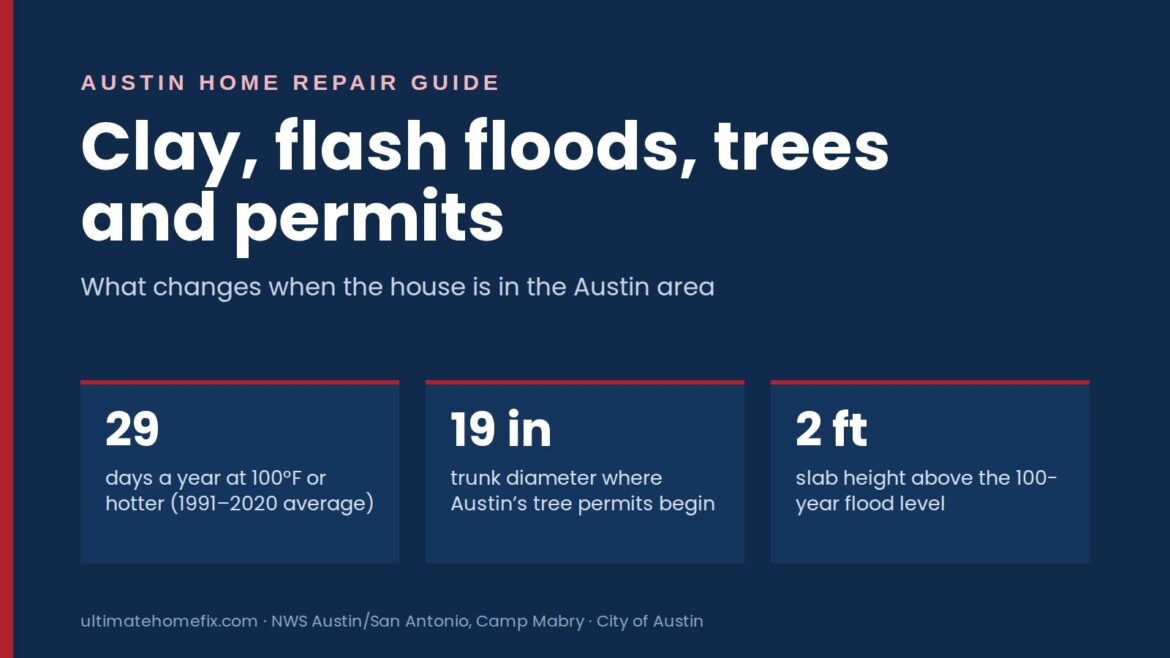
Fixing a house in Austin is not the same job as fixing one in Dallas–Fort Worth or Houston. Five things change the answer here: a fault line that splits the metro into rock on one side and swelling clay on the other, some of the worst flash flooding in the country, big trees that the city protects and ice storms that bring them down, a city-owned electric utility with its own rebates and rules, and permit rules that differ more between Austin and its suburbs than most people expect. This guide covers what is specific to the Austin area and points to our deeper guides where the answer is the same statewide.
Everything below was checked against the agencies and cities that set the rules: the National Weather Service, the City of Austin, Austin Energy, the Texas Department of Insurance, the USDA and each suburb’s own website. Where a city does not say, we say so instead of guessing.
The ground: limestone on one side, expanding clay on the other
Austin sits on the Balcones Fault Zone. According to the University of Texas Bureau of Economic Geology, the east side of Austin dropped by as much as 700 feet along the faults, which is why the city is hilly west of MoPac and relatively flat east of it. West of the escarpment the soils are “thin and rocky” over limestone. East of it you are on the Blackland Prairie.
The Blackland Prairie clays are the ones that move foundations. The USDA describes the Houston Black series, the state soil of Texas, as a very deep clay with “high shrink-swell potential”: when it dries, cracks up to 4 inches wide open a foot or more deep. Heiden clay, also common east of Austin, has cracks open for a total of 90 to 150 days in a normal year. Branyon clay on the stream terraces cracks 1 to 3 inches wide and 20 inches or more deep. The Texas Water Development Board puts it plainly: these soils “shrink and swell markedly with changes in moisture content,” which “commonly is a limitation affecting building site development.”
Two details trip people up. First, the Austin soil series, which shares the city’s name, is a moderately deep silty clay over chalk, and the Eddy series is a shallow, gravelly soil over chalk; neither is the deep Blackland clay described above. Second, the Del Rio clay, a geologic layer with very plastic, swelling clay, turns up in central Austin too: a City-commissioned study of a 2018 slope failure along Shoal Creek in Pease Park found it beneath the slope. So “west side means no clay” is not a safe rule. To see what is under your own lot, look up the address on the USDA’s free Web Soil Survey.
What this means for you: a slab on the east side of the metro moves with the seasons more than one on Hill Country rock. Small cosmetic cracks are normal; doors that stick, cracks that keep widening and gaps at window frames are worth an engineer’s look. Our foundation repair cost guide covers prices, which pier type suits clay, and when to repair versus replace.
Caves, sinkholes and the Edwards Aquifer
Southwest of downtown, the ground is karst limestone. The City of Austin says that across the Edwards Aquifer recharge zone “caves, sinkholes and faults are common,” and dye traces showed water traveling from Onion Creek near Buda to Barton Springs in as little as three days. That is why the area has its own building limits. In the Barton Springs Zone, Austin’s 1992 Save Our Springs Ordinance caps impervious cover at 15% of a site in the recharge zone and 20% to 25% in the contributing zones.
State rules can reach a single house as well. The Texas Commission on Environmental Quality says construction at a private residence over the recharge or contributing zone falls under its Edwards Aquifer rules, and a teardown and rebuild may need an Edwards Aquifer application. A home is exempt if it is part of a master-planned community with an approved plan, sits alone on a lot larger than five acres, or keeps impervious cover (rooftops, driveways, slabs, sheds, sidewalks) at 20% or less, including by harvesting rooftop rainwater to bring the adjusted figure down to 20%. If you are planning a big addition, a pool deck or a rebuild in southwest Austin or the Hill Country, call TCEQ’s Austin regional office (512-339-2929) before you design it.
Watering and the foundation
Steady soil moisture is kinder to a slab than wet-dry swings, but each city sets its own watering rules, and they are stricter than many people assume. Here is what each city’s own site says as of October 9, 2026:
| City | Current stage (per the city) | Foundation watering |
|---|---|---|
| Austin | Conservation Stage since Sep 2, 2025 (the year-round baseline, not a drought stage) | Allowed on your assigned watering day and hours; aim sprinklers about 18 inches from the slab. A hand-held hose is allowed any time. Banned only in Emergency Stage 5. |
| Round Rock | Year-Round Water Use Standards | Drip and soaker hoses are not exempt; they follow your two watering days. A hand-held hose is allowed any time. In Stage III, foundations may be watered by hand-held hose only, on the city’s schedule. |
| Cedar Park | Stage 1 (city FAQ; in effect since July 10, 2025) | A drip or soaker hose may be used any time. In the most severe stages, hand, soaker and drip watering is limited to trees, foundations and gardens. |
| Georgetown | Stage 1, two days a week | Not addressed separately. No watering on Mondays or from 9 a.m. to 7 p.m.; drip and soaker hoses follow the schedule; a hand-held hose is allowed any time. |
| Pflugerville | Check the city’s current notice | City code: allowed in Stage 1, on your designated day before 10 a.m. or after 7 p.m. in Stage 2, prohibited in Stage 3. During a March 2026 emergency the city still allowed foundation watering as the one outdoor exception. |
The lakes are in good shape for now: on October 9, 2026, the Texas Water Development Board showed Lake Travis about 95% full and Lake Buchanan about 96% full, after the Lower Colorado River Authority reported both lakes filled in July 2026 for the first time since 2019. Stages change, so check your city’s current notice before you set a timer. We did not find official guidance from any of these cities on how much to water a foundation, so we won’t invent a schedule. What matters more is drainage: water that pools against the slab after every storm does more harm than a dry August. Our drainage case study shows what fixing that looks like, and gutters are usually the first step.
Flash Flood Alley: why a dry creek is not a safe creek
The National Weather Service office for Austin and San Antonio says it directly: “South Central Texas is commonly referred to as Flash Flood Alley,” and flash flooding is the leading cause of weather-related deaths in the region. The Lower Colorado River Authority blames the combination of “steep terrain, shallow soil and unusually high rainfall rates.” The City of Austin adds that about 75% of Texas flood deaths happen in vehicles. Check road closures on ATXfloods.com before driving in heavy rain, and sign up for alerts at WarnCentralTexas.org.
| Date | Event | What happened (official figures) |
|---|---|---|
| May 1981 | Memorial Day flood | Devastated lower Shoal Creek and claimed 13 lives, according to the City of Austin; voters later approved a drainage fee and bonds |
| Oct 31, 2013 | Halloween flood | About 14 in of rain between Wimberley and Driftwood; Onion Creek at Hwy 183 peaked near 41 ft, well above its 36.5 ft gauged record (USGS) |
| May 23–25, 2015 | Memorial Day flood | The Blanco River at Wimberley rose 5 ft every 15 minutes, passed 41 ft by 1 a.m. and crested at an estimated 45 ft, its flood of record; 11 deaths near Wimberley and at least 24 statewide |
| Oct 2018 | Llano River flood | Lake Travis reached 704.39 ft, its fifth-highest level; silt from the floodwater forced a citywide boil-water notice from Oct 22 to Oct 28 |
| July 4, 2025 | Hill Country floods | At least 135 deaths, 117 of them in Kerr County (U.S. Commerce Department Inspector General); 10 bodies recovered in Travis County as of July 22, 2025 (Travis County Sheriff) |
| July 2026 | Hill Country rains | More than 20 in of rain in a week over parts of the Hill Country; Lakes Buchanan and Travis filled for the first time since 2019 (LCRA) |
Two more facts worth knowing. Lake Travis is the only Highland Lake designed to hold floodwater, but the LCRA notes it “cannot prevent flooding along creeks and streams” that feed the Colorado River. The City has approved $95.5 million of its own money for buying out flood-prone homes along Onion Creek (194 bought by September 2016) and expanded that program after the 2013 flood; after a second Halloween flood in 2015 it added Williamson Creek.
Austin’s floodplain is bigger than FEMA’s map
About 10% of Austin’s land is in the floodplain. In November 2019 the City updated its floodplain rules after NOAA’s Atlas 14 rainfall study showed that the old “100-year” storm was too small. Until new floodplain maps are finished, the City regulates the current FEMA 500-year floodplain as its 100-year floodplain. New or rebuilt slabs there must sit at least 2 feet above the 100-year flood elevation (up from 1 foot), and remodels or repairs of buildings in the floodplain need a cost estimate because the City limits how much work can be done. (The Colorado River’s own regulatory floodplain was not changed by these rules.) Under the federal flood insurance program’s rules, when repairs or improvements reach 50% of a home’s market value (“substantial damage” or “substantial improvement”), the whole home must be brought up to current floodplain standards.
The catch: FEMA’s insurance maps for Austin have not yet been redrawn with the Atlas 14 rainfall. A house can be inside the City’s regulatory floodplain for permits while FEMA’s map still shows it outside the high-risk zone, so your lender may not require flood insurance even though the City treats you as in the floodplain. Check both before you buy, remodel or rebuild.
Flood insurance and the drainage charge
- Your home policy won’t pay for flooding. The Texas Department of Insurance: a standard homeowners policy “won’t pay for flooding.”
- Most flood policies have a 30-day waiting period (TDI), so buy it in spring, not when a storm is on the radar. NFIP limits are $250,000 for the building and $100,000 for contents.
- Outside the floodplain still floods. FEMA says about one-third of flood insurance claims from 2013 to 2023 came from outside high-risk areas.
- Drainage charge: Austin bills it by your property’s impervious cover. For fiscal 2026–27 the base rate is $0.0063 per square foot per month, starting with November 2026 bills, multiplied by a factor that rises with the share of your lot that is paved or roofed. A new patio or a wider driveway raises it.
Trees: the Austin rule that surprises newcomers
Austin regulates trees on private residential lots, which matters for any foundation repair, driveway, addition or fence near a big tree. The City Arborist’s rules:
- Protected trees measure 19 inches or more in diameter at 4.5 feet above the ground. Removing one needs a permit.
- Heritage trees measure 24 inches or more and are one of these species: all oaks, pecan, cedar elm, American elm, bald cypress, Texas ash, Texas madrone, bigtooth maple, Arizona walnut and eastern black walnut. Removing a heritage tree is prohibited except as the code allows (Section 25-8-641).
- Trees under 19 inches are not regulated on residential property.
- You need a Tree Ordinance Review Application to remove a regulated tree, prune 25% or more of its canopy, or disturb its critical root zone. Review takes up to 10 business days, and qualifying applications have the fee waived.
- The root zone rules are what catch contractors: no work at all in the inner quarter of the critical root zone, no cut or fill deeper than 4 inches within the inner half, and at least half of the whole root zone left undisturbed. Ask any foundation, driveway or fence contractor how they will meet them.
- Dead or dangerous trees still need a permit before removal, with photos. Whether you can trim a neighbor’s overhanging limbs is a civil matter between neighbors, but if the tree is 19 inches or more, the City’s 25% canopy limit still applies.
Ice is the other tree story. Winter Storm Mara, from January 30 to February 2, 2023, left about 0.71 inch of ice in central Austin, which Austin Energy called the worst ice storm in the city’s history. At the peak, 173,879 Austin Energy customers (32%) were without power; the utility later estimated 10.5 million trees were damaged, and the City collected more than 170,000 tons of storm debris from February 3 to April 19, 2023. If big limbs hang over your roof or service line, have them looked at before winter. One timing rule for oaks: the Texas A&M Forest Service says not to prune or wound oaks from February through June because of oak wilt, and to paint any wound on an oak, whatever the season.
Wildfire: the WUI code and your next roof
Austin has its own Wildland-Urban Interface (WUI) Code. It took effect January 1, 2021, and the updated 2024 version took effect July 10, 2025. The City says more than half of Austin falls into one of its three WUI zones; its interactive map shows whether yours does. Existing homes do not have to be retrofitted, but new homes, the new or revised parts of additions and alterations, and big re-roofs do have to comply: replacing 50% or more of a roof means the whole roof must meet the code. The requirements depend on the zone (A, B or C, by distance from wildland). In every zone they include a Class A roof, ember-resistant vents with openings no larger than 1/8 inch, a 5-foot noncombustible zone around the house, and noncombustible gutters with leaf guards; the closer zones add ignition-resistant exterior walls and fire-resistant fencing within 10 feet of the house.
The code applies within Austin’s full- and limited-purpose jurisdiction but not in its extraterritorial jurisdiction (ETJ), and Travis County’s fire code has no WUI provisions. The risk does not stop at the city line, though: the 2011 Bastrop County Complex fire burned 34,068 acres and destroyed 1,667 homes, the most homes lost to any wildfire in Texas, according to the Texas A&M Forest Service. Our roof replacement cost guide covers what a Class A roof costs.
Heat: plan for a month of 100-degree days
At Camp Mabry, Austin’s official weather station, the National Weather Service puts the 1991–2020 average at 29 days a year at 100°F or hotter; its normals also show about 123 days a year at 90°F or hotter. The record is 90 days of 100°F in 2011; 2023 came second with 80 and brought the hottest July on record, averaging 90.8°F. Heat like that is hard on air conditioners, attics and roofs.
- Efficiency floor: a new split-system central AC under 45,000 Btu/h installed in Texas must be at least 14.3 SEER2 (federal rule since January 1, 2023). See what SEER2 and the refrigerant change mean for you.
- Attic first: insulation and duct sealing are what Austin Energy’s own rebates target (see below), and they cut the load the AC has to carry. Compare attic insulation costs.
- Slow leaks: a clogged condensate line is one of the most common summer leaks.
For the big decisions, see AC replacement costs and repair or replace.
Freezes: the east side gets colder
Camp Mabry averages about 12 nights a year at or below freezing, but Austin-Bergstrom airport, on the east side, averages 33; the National Weather Service notes Bergstrom’s lows can sometimes be 10 degrees colder. If you live out east near the airport, plan for more hard freezes than the Camp Mabry numbers suggest.
Winter Storm Uri set the benchmark. National Weather Service records show Camp Mabry hit 7°F on February 16, 2021 and stayed at or below freezing for 144 straight hours, a record; Bergstrom recorded 162 hours. The City’s review found more than 40% of Austin Energy customers without power on February 16, 2,449 calls to the fire department about broken pipes, and seven days under a citywide boil-water notice. The state health department counted 28 storm-related deaths in Travis County and 6 in Williamson County. The cold has come back since: Camp Mabry set record lows of 20°F and 18°F on February 19 and 20, 2025.
Austin Water is responsible for the meter and the public side; the service line past the meter and everything inside are yours. Know where your shutoff is, and for leaks call Austin Water’s 24-hour line (512-972-1000). Income-qualified households can get up to $15,000 in grants through the City’s Plumbing Repair Program. Before the next freeze, winterize outdoor pipes and faucets, read how to protect your pipes before the next cold snap, and work through the Texas fall and winter checklist. If your water heater lives in the attic, our attic water heater guide covers the drain pan and permit rules.
Hail, tornadoes and wind
Hail, tornadoes and straight-line winds all reach the Austin metro, and the northern suburbs have taken some of the biggest hits.
| Date | Storm | What happened (official figures) |
|---|---|---|
| Feb 2021 | Winter Storm Uri | 7°F at Camp Mabry and 144 straight hours at or below freezing; more than 40% of Austin Energy customers out; citywide boil-water notice |
| Mar 21, 2022 | Round Rock tornado | EF2 on a 29-mile path across Travis and Williamson counties; Round Rock reported more than $32 million in damage and more than 680 homes affected |
| Jan 30–Feb 2, 2023 | Winter Storm Mara | About 0.71 in of ice; Austin Energy peak of 173,879 customers (32%) out; more than 170,000 tons of debris |
| Sep 24, 2023 | Round Rock hailstorm | Hail up to 4 in (softball size) in Round Rock, over 2 in in Georgetown and up to 2.25 in in Austin; over $600 million in estimated damage (NWS) |
| May 9, 2024 | Hays County hail and wind | Tennis-ball-size hail in San Marcos and southeast Hays County; gusts estimated at 80 mph |
| May 28, 2025 | Austin microburst | 77 mph measured at Austin-Bergstrom, tied for its third-strongest gust; more than 124,000 Austin Energy customers affected, the third-worst storm in the utility’s history |
Sources: NWS Austin/San Antonio climate records and storm summaries, the City of Austin’s Uri review, Austin Energy and the City of Round Rock. Links are in the Sources list at the end.
Insurance and storm-chasing roofers
The Austin metro is not in the Texas Windstorm Insurance Association’s coastal area, so wind and hail claims normally go through your regular homeowners policy rather than a separate windstorm policy. TDI notes that the deductible for wind and hail damage is often more than for other damage, and a deductible can be a percentage of your coverage: its example is a 5% deductible, or $7,500, on a home insured for $150,000. As roofs age, TDI adds, some companies switch roof coverage to actual cash value. It is illegal in Texas for a contractor to waive or absorb your deductible; contracts of $1,000 or more paid by insurance must include a deductible notice; and a roofer working on your house cannot also act as your public adjuster. Before you file, run the numbers with our deductible calculator and decide whether to claim or pay cash. Then check every bid against the bid red-flags checklist. The 2026 Texas insurance changes apply here too.
Utilities: why Austin Energy changes the math
Austin Energy is owned by the City of Austin; as the utility puts it, Austinites have owned their electric utility since 1895. Texas lets city-owned utilities decide whether to join the state’s retail electricity market, and Austin Energy has not, so its customers do not shop for a retail electric provider; the City Council sets its rates. Its service area covers about 437 square miles, only about half of it inside Austin’s city limits. Next door the picture changes, so check your provider by address:
- Austin Energy: most of Austin, plus all or parts of Bee Cave, Lakeway (south and east of Hurst Creek), Rollingwood, West Lake Hills, Sunset Valley, Pflugerville and Cedar Park. Outages: 512-322-9100 or text OUT to 287246.
- Oncor: Round Rock, where you choose a retail provider on the state’s Power to Choose site. Outages: 888-313-4747.
- Pedernales Electric Cooperative (PEC): Leander and the part of Lakeway that Austin Energy doesn’t serve. Outages: 888-883-3379.
- Georgetown: served by the city’s own Georgetown Electric, Oncor or PEC depending on the address.
- Bluebonnet Electric Cooperative serves parts of 14 Central Texas counties. Outages: 800-949-4414.
- Gas: Texas Gas Service in Austin, Cedar Park, Georgetown, Pflugerville, Kyle, Buda and Lakeway (800-959-5325); Atmos Energy in Round Rock and Leander (866-322-8667). If you smell gas, leave the house first, then call 911 and the gas company.
Austin Energy rebates worth knowing before a repair
Because the rebates come from the utility, they apply only to Austin Energy customers, and nearly all of them require an Austin Energy participating contractor. Amounts as posted on Austin Energy’s site:
| Program | What it pays | The fine print |
|---|---|---|
| AC and heat pump rebate | $600–$800 for AC; $650–$950 for heat pumps, by efficiency tier | Participating contractor; City permits and an Austin Energy inspection; home and old system at least 10 years old; Manual J sizing |
| Home Energy Savings | Rebates averaging about $3,000 when you bundle at least 3 upgrades (attic insulation, duct sealing, duct replacement, solar screens, AC); higher AC rebates inside the bundle | Participating contractor; home at least 10 years old; loans of $1,500 to $25,000 (offered at 0% for a limited time; confirm the current rate) |
| Solar | $4,000 (up from $2,500 on July 1, 2026) | System of at least 3 kW; participating contractor; rebate confirmed before installation |
| Heat pump water heater | $1,000 | Listed on Austin Energy’s residential rebates page |
| Power Partner thermostat | $50 to buy, $75 to enroll, then $30 a year | Central AC or heat pump required |
| Weatherization Assistance | Free attic insulation and duct repair | Income-qualified households only |
Austin Water adds landscape and irrigation rebates (up to $3,000 for a WaterWise landscape and up to $1,000 for irrigation upgrades). Programs are first-come, first-served and change without notice, so confirm before you sign a contract, and see our savings and rebates guide for statewide options.
Selling an older home in Austin: the energy audit
Under Austin’s Energy Conservation Audit and Disclosure (ECAD) ordinance, a home that is inside the city limits, served by Austin Energy and at least 10 years old needs an energy audit before it is sold. The results go to the buyer at least three days before the option period ends. Austin Energy says audits typically cost $200 to $300 for a home of 1,800 square feet or less and are valid for 10 years. A home is exempt if, within the past 10 years, it went through Home Energy Savings or Weatherization Assistance, got three or more qualifying efficiency improvements, or earned at least $500 in Austin Energy efficiency rebates (solar, Austin Water and other City rebates don’t count toward the $500). Homes outside the city limits or outside Austin Energy’s territory are exempt too.
Generators and home batteries
Backup power works differently in Austin than in Houston. A 2025 state law (SB 1252) bars cities from regulating the installation or inspection of home backup systems of 50 kW or less (or batteries of 100 kWh or less), but it does not limit a city-owned electric utility, such as Austin Energy, within its own service area. Austin’s permit pages don’t mention SB 1252. They use another 2025 state law, SB 1202, which lets a third party review the job: for a generator, battery or solar system up to 600 volts on a one- or two-family home, the contractor files a stand-alone permit with a compliance letter signed by a licensed engineer, master electrician or certified inspector, and the City must issue the permit within three business days. A separate electrical permit is still needed if the job requires a shutdown, and a plumbing permit for gas or propane; Austin Energy’s own permit for solar and batteries still applies. SB 1252 note: Round Rock, Cedar Park and Georgetown still list generator permits on their websites, although Round Rock and Cedar Park don’t own their electric utilities, so ask the city whether its permit still applies to your job. The gas line to a generator is plumbing work with its own rules.
Building codes and permits around Austin
Austin and its suburbs are on different code editions, and Austin is the odd one out on plumbing and mechanical: it uses the Uniform Plumbing and Mechanical Codes, while the suburbs below use the International codes.
| City | Residential code | Electrical code (as posted) | Plumbing / energy |
|---|---|---|---|
| Austin | 2024 IRC with local amendments, effective July 10, 2025 | 2026 NEC from Sep 1, 2026 | 2024 Uniform Plumbing Code; 2024 IECC |
| Round Rock | 2024 IRC | 2023 NEC | 2024 IPC; 2024 IECC |
| Cedar Park | 2021 IRC, effective June 1, 2022 | 2020 NEC | 2021 IPC; 2021 IECC |
| Georgetown | 2021 IRC, effective Nov 1, 2023 | 2023 NEC | 2021 IPC; 2021 IECC |
| Leander | 2021 IRC | 2023 NEC with local amendments | 2021 IPC; 2021 IECC |
| Pflugerville | 2021 IRC with amendments | 2020 NEC | 2021 IPC; 2021 IECC |
| Kyle | 2021 IRC | 2020 NEC | 2021 IPC; 2021 IECC |
| Unincorporated Travis County | IRC (2008 edition, or Austin’s version) for new homes and for additions that increase a home’s size or value by more than 50%; new homes need at least three inspections | Not specified | — |
The 2026 National Electrical Code took effect statewide in Texas on September 1, 2026. Austin has adopted it; several suburbs still post the 2020 or 2023 edition, so ask your permit office which edition your job will be reviewed under.
Does this job need a permit?
| Job | Austin | Round Rock | Cedar Park | Georgetown |
|---|---|---|---|---|
| Roof replacement | No for shingles replacing shingles; yes if more than 128 sq ft of decking is replaced, or 50%+ of the roof in a WUI zone | No for a re-roof; yes if the roof structure changes | No (non-structural roof covering) | Yes ($60) |
| Fence | No up to 7 ft outside a flood hazard area (solid property-line fences are limited to 6 ft, or 7 ft with a 1-ft grade change); yes over 7 ft or in a floodplain | No building permit; height and material rules still apply | No permit; city ordinance still applies | Yes for a new fence or replacing more than 1/3 of one |
| Water heater | Yes, by our reading: not on the City’s exempt list, and the City offers a plumbing change-out permit | Likely yes under the city’s general rule; $50 permit to switch to tankless | Yes | Yes |
| HVAC replacement | Yes (mechanical permit) | Yes ($50) | Yes | Yes under the city’s general rule |
| Foundation repair | Yes (Express permit), unless 128 sq ft or less | Check (512-218-5550) | Check | Yes |
| Window replacement | Yes (Express permit), even size for size; enlarging an opening needs a standard permit | No, but must meet code | Check | Check |
| Electrical panel | Yes | Yes ($50), with a torque letter | Likely yes; confirm with the city | Yes |
| Deck | No if 200 sq ft or less, 30 in or less above grade, detached, not serving an exit door and outside a flood hazard area; otherwise yes | Yes ($125 uncovered) | Check | Yes |
| Standby generator | Yes (stand-alone permit; see the backup-power section above) | City site lists a permit ($150); see the SB 1252 note | City site lists a permit; see the SB 1252 note | City site lists a permit ($70 plus trade permits); see the SB 1252 note |
“Check” means the city’s current website doesn’t say; call the permit office. Pflugerville’s site does not list job-by-job rules, and Kyle requires permits for window and exterior door replacement, water heaters, HVAC, most decks, irrigation and solar. Exempt from a permit does not mean anything goes: in Austin a fence over 6 feet along a public right-of-way needs a permit and a variance, and corner lots have sight-line rules. Austin’s online “Do I Need a Permit?” tool is a good first stop, but the City says its answers should be confirmed with staff.
Can you pull your own permit?
- Austin: yes, through a Homestead Permit, if you have a homestead exemption on file and the work is on your own principal residence. You can do your own electrical, plumbing and mechanical work, but not the main electric service, recharging an air-conditioning system with refrigerant, propane piping, or auxiliary water systems (see the Texas rules on DIY AC recharging). You must do all the work yourself, and the permit may be suspended or revoked if anyone else does it; you also can’t have used a homestead permit on a different home in the previous 12 months. For building permits you can act as your own general contractor, but you must register with the City first. The City moved some homestead rules into its Building Criteria Manual in its 2026 electrical code update, so confirm the details with Development Services.
- Round Rock: homeowners may act as their own contractor on their primary residence even if unlicensed; normal permits, fees and inspections apply, and contractor registration is free.
- Georgetown: a Homestead Exemption permit lets an unlicensed owner do plumbing, electrical and mechanical work in a home they own and live in, with a signed affidavit and proof of ownership from the Williamson County Appraisal District. It does not cover rentals.
- Kyle: you must show proof of homestead to do permitted work yourself, and some work must be done by a licensed professional.
State licensing exemptions for homeowners do not waive city permits. See the Texas home repairs you are not allowed to do yourself.
Austin rules that catch remodels
- Historic review: in Austin, demolishing or changing the exterior of a structure 45 years old or older triggers historic review, as does work in a historic district or on a landmark. For landmarks and contributing homes in historic districts, routine maintenance and in-kind repairs don’t need historic review, but exterior alterations do; ask the Historic Preservation Office before changing materials.
- Size limits: the City’s Residential Design and Compatibility Standards, often called the McMansion rules, limit the scale of additions and remodels in central neighborhoods.
- More units allowed: since the 2023–2024 HOME amendments, lots zoned SF-1, SF-2 and SF-3 can hold up to three housing units, including tiny homes, which opens options for an accessory unit instead of an addition.
- Impervious cover: zoning limits how much of your lot can be roofed or paved, and it also drives the drainage charge. Check before adding a patio or widening a driveway.
- Help: Development Services answers at 512-978-4000 during business hours; permits are filed through the City’s AB+C portal.
Licenses and checking a contractor
Texas licenses electricians and air-conditioning contractors (TDLR), plumbers (State Board of Plumbing Examiners) and irrigators (TCEQ). Texas still does not license roofers or general contractors. In Austin, electrical, mechanical and plumbing contractors also need City registration renewed every year, and general contractors, including homeowners acting as their own, must register once. Georgetown and Round Rock also require contractors to register, for free. Before you sign, read how to read a contractor bid.
What repairs cost in Austin
Our cost guides cover Texas as a whole. A few Austin-area items can change a job’s cost: tree-permit requirements near large trees, WUI-compliant roofing and vents, Express permits for windows and foundation work, floodplain limits, and the Austin Energy rebates that can take hundreds or thousands off an AC or insulation job. Start here:
- Foundation repair costs in Texas
- Roof replacement costs
- AC replacement costs
- Attic insulation costs
- Window replacement costs
- Water heater replacement costs
- Electrical panel upgrade costs
- Fence installation and repair costs
- Water damage and mold remediation costs
- Repiping costs
Where to start
- Look up your lot on the USDA Web Soil Survey and the City’s floodplain and WUI maps, so you know whether you are dealing with clay, flooding, wildfire rules or all three.
- If you don’t have flood insurance, buy it now. Most policies take 30 days to start.
- Before any work near a big tree, measure it. At 19 inches across, Austin’s tree rules apply.
- If Austin Energy serves you, check the rebates before you replace an AC or insulate the attic, and hire a participating contractor.
- Run the deductible calculator so you know what a roof claim would actually pay, and check bids against the red-flags checklist.
- Protect exposed pipes before the first freeze warning, especially on the east side.
Where these numbers come from, and what they are not
The facts on this page were checked on October 9, 2026 against the agency and city sources listed below. Codes, permit rules, watering stages, rebates and insurance rules change, and suburbs update their websites on their own schedules, so confirm with your permit office, utility or insurer before you start a job. This page is general information, not legal, engineering or insurance advice. How we research prices and rules.
Some of the guides linked here contain affiliate links; see our disclosure. There is no lead form on this page and no one pays to be mentioned on it. Spot something out of date? Tell us.
Written by Jimmy Hall, a Texas homeowner, not a contractor, plumber, electrician or adjuster. Why that matters.
Sources
- UT Bureau of Economic Geology — Central Texas (Balcones Fault Zone)
- USDA NRCS — Soils of Texas (state soil)
- Texas Water Development Board — Texas state soil (Houston Black)
- USDA NRCS — Houston Black official soil series description
- USDA NRCS — Heiden official soil series description
- USDA NRCS — Branyon official soil series description
- USDA NRCS — Austin official soil series description
- USDA NRCS — Eddy official soil series description
- City of Austin — Pease Park slope failure assessment (2018)
- USDA NRCS — Web Soil Survey
- City of Austin — The Edwards Aquifer: Austin underground
- City of Austin — Save Our Springs Ordinance
- TCEQ — Edwards Aquifer: private residences
- Austin Water — Drought response
- Austin Water — Find your watering day
- City of Round Rock — Water
- City of Round Rock — Watering your lawn
- City of Round Rock — Drought Contingency Plan (2024)
- City of Cedar Park — Water conservation FAQ
- City of Cedar Park — Drought contingency ordinance (Art. 18.08)
- City of Georgetown — Water utility
- City of Pflugerville — Code, water conservation (Art. VII)
- City of Pflugerville — March 2026 water emergency alert
- Texas Water Development Board — Lake Travis
- Texas Water Development Board — Lake Buchanan
- LCRA — Floodgate operations at Buchanan Dam (July 2026)
- NWS Austin/San Antonio — Flash Flood Alley
- LCRA — Flood management
- LCRA — Dams and lakes (Lake Travis records)
- City of Austin — ATX flood safety
- City of Austin — Flooding
- City of Austin — Watershed profiles, North Urban (1981 flood)
- NWS Austin/San Antonio — October 31, 2013 flood summary
- USGS — Onion Creek flood, October 31, 2013
- City of Austin Auditor — Flood buyout program (2017)
- NWS Austin/San Antonio — Memorial Day 2015 flood summary
- NOAA Repository — Furl et al., the 2015 Blanco River flood
- Austin/Travis County — Colorado River flooding after-action report (2019)
- U.S. Dept. of Commerce OIG — July 2025 Texas Hill Country flood report
- Travis County Sheriff’s Office — July 5 flood update (July 22, 2025)
- City of Austin — Floodplain management
- City of Austin — Atlas 14 summary of code changes
- City of Austin — Floodplain regulations
- 44 CFR 59.1 — Substantial damage and substantial improvement
- Texas Department of Insurance — How much does flood insurance cost?
- Texas Department of Insurance — Home insurance FAQ
- FEMA — NFIP fast facts (Nov 2024)
- City of Austin — Drainage charge
- City of Austin — City Arborist
- City of Austin — Trees on residential property
- City of Austin — Dead, diseased and imminent-hazard trees
- Austin Energy — Winter storm briefing to the Utility Oversight Committee (Feb 2023)
- Austin Energy — History
- Austin Resource Recovery — Winter Storm Mara after-action report
- Texas A&M Forest Service — Oak wilt
- City of Austin — Wildland-Urban Interface Code
- Travis County — Fire Code (Ch. 201)
- Texas A&M Forest Service — Largest wildfires in Texas
- NWS Austin/San Antonio — Camp Mabry temperature rankings
- NWS Austin/San Antonio — Camp Mabry monthly records
- NWS Austin/San Antonio — Camp Mabry monthly normals
- NWS Austin/San Antonio — Austin-Bergstrom monthly normals
- NWS Austin/San Antonio — Austin climate summary
- U.S. DOE — 2023 central AC standards FAQ
- NWS Austin/San Antonio — Camp Mabry February records
- NWS Austin/San Antonio — Camp Mabry climate records table
- NWS Austin/San Antonio — Austin-Bergstrom climate records table
- City of Austin and Travis County — Winter Storm Uri after-action findings
- Texas DSHS — February 2021 winter storm mortality report
- Austin Water — Water leaks
- NWS Austin/San Antonio — March 21, 2022 tornadoes
- City of Round Rock — Tornado recovery (Sep 2022)
- NWS Austin/San Antonio — Winter Storm Mara story map
- NWS Austin/San Antonio — September 24, 2023 hailstorm
- NWS Austin/San Antonio — May 9, 2024 hail and wind
- NWS Austin/San Antonio — May 28, 2025 microburst
- Austin Energy — Full impact of the May 2025 microburst
- Texas Department of Insurance — Homeowners losses by county (TWIA counties)
- Texas Department of Insurance — Deductibles
- Texas Department of Insurance — Replacing your roof
- Texas Department of Insurance — Can a contractor waive my deductible?
- Texas Department of Insurance — Roofing and insurance: know the law
- Public Utility Commission of Texas — Municipal utilities FAQ
- Austin Energy — Company profile
- Austin Energy — Service area map
- Austin Energy — Using the outage map
- City of Round Rock — Get winter weather ready (Oncor)
- City of Leander — Utilities
- City of Lakeway — Electric service providers
- City of Georgetown — Electric providers
- PEC — Reporting power outages
- Bluebonnet Electric Cooperative — Outages
- Texas Gas Service — Central-Gulf service area
- Texas Gas Service — How to detect a leak
- Atmos Energy — Storm center and gas emergencies
- Austin Energy — Residential rebates
- Austin Energy — AC and heat pump rebates
- Austin Energy — Home Energy Savings
- Austin Energy — Solar for your home
- Austin Energy — Solar incentive increase (2026)
- Austin Energy — Power Partner thermostat
- Austin Energy — Weatherization Assistance
- Austin Water — Rebates, tools and programs
- Austin Energy — ECAD for home sellers
- Austin Energy — ECAD exemptions
- Texas Department of Insurance — What to know about replacing your roof with insurance (2026)
- City of Round Rock — Standalone trade permits
- Bluebonnet Electric Cooperative — About us
- City of Austin — Historic review
- TDLR — SB 1252 changes to residential energy backup system regulations
- Texas Legislature — SB 1252 (2025), enrolled text
- Texas Legislature — SB 1202 (2025), enrolled text
- City of Austin — Stand-alone permits (home backup power)
- Austin Energy — Solar permitting manual (2026)
- City of Austin — Building technical codes
- City of Austin — 2026 NEC adoption briefing (Apr 2026)
- TDLR — Commission adopts 2026 NEC (16 TAC §73.100)
- City of Round Rock — Building Inspection
- City of Cedar Park — Building permits and inspections
- City of Georgetown — Adopted building codes
- City of Pflugerville — Code §150.02 (building codes)
- City of Leander — Building codes
- City of Kyle — Building services
- Travis County — Code Ch. 480 (residential construction)
- City of Austin — Work exempt from building permits
- City of Austin — Express permits
- City of Austin — Fencing regulations
- City of Austin — Residential plan review
- City of Austin — Do I need a permit?
- City of Round Rock — Homeowner projects
- City of Cedar Park — Do I need a permit?
- City of Georgetown — Re-roof permits
- City of Georgetown — Fence permits
- City of Georgetown — Residential permits
- City of Georgetown — Generator permits
- City of Georgetown — Contractor registration and homestead exemption
- City of Austin — Homeowner’s permit (Homestead Permit)
- City of Austin — Contractor registration
- City of Austin — HOME amendments
- City of Austin — Residential Design and Compatibility Standards
- City of Austin — Historic preservation review
- City of Austin — Homeowner permitting resources
- Texas Occupations Code Ch. 1305 — Electricians
- TSBPE — License types
- TDLR — Air conditioning and refrigeration contractors
- TCEQ — Landscape irrigation rules (RG-470)
- Texas Legislature — HB 3344 (2025) bill history